

The Four Human Drivers of Search Behaviour

Understanding The Four Human Drivers Of Search Behaviour
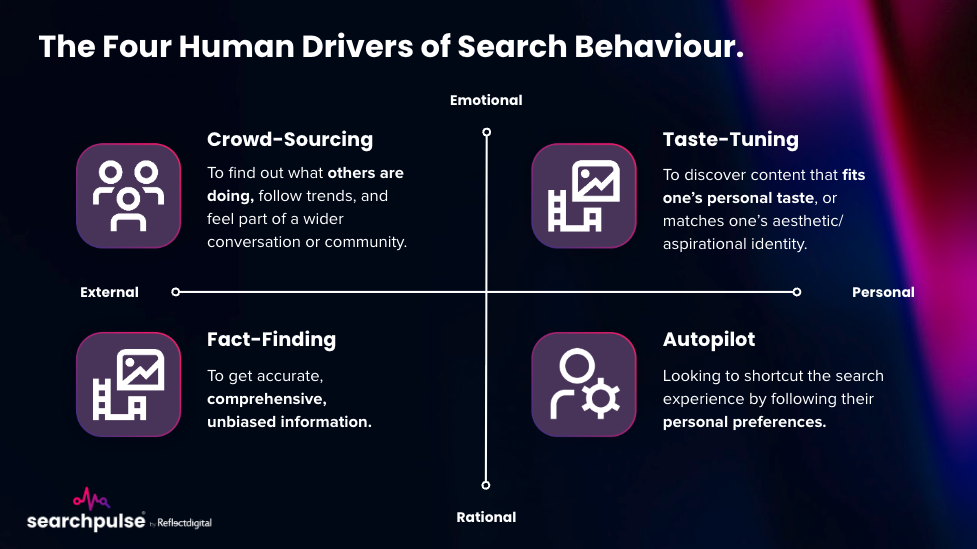
Search behaviour isn’t random. Behind every query, swipe, scroll, or prompt is a human motivation shaping what people do next. In our SearchPulse research, these motivations consistently fall into four core drivers, mapped across two key dimensions:
-
Emotional ↔ Rational (why someone is searching)
-
External ↔ Personal (who or what they’re guided by)
Together, these create a quadrant that helps explain not just where people search, but what action they’re trying to take, and why different platforms win at different moments.
This framework is essential for understanding why Google, TikTok, Instagram, Reddit, and AI tools like ChatGPT show up so differently across the modern search journey.
Below, we break down each driver, what it means in practice, and where search and social platforms tend to sit when users are operating in each mode.
Crowd Sourcing
External × Emotional
What’s driving the behaviour?
Users are looking to see what others are doing. This is about validation, trends, social proof, and feeling part of a wider conversation or community.
Rather than asking “what’s correct?”, users are asking: What are people like me choosing? What’s popular right now? What’s getting talked about?
The action users are taking
-
Exploring options
-
Sense‑checking choices
-
Looking for reassurance through others’ behaviour
Where platforms show up
-
TikTok & Instagram thrive here, surfacing trends, peer recommendations, and creator-led discovery.
-
Reddit plays a powerful role, especially for honest opinions and lived experiences.
-
YouTube supports deeper community-led exploration through reviews and commentary.
In this quadrant, visibility is driven less by optimisation and more by participation: creators, communities, and cultural relevance.
Taste-Tuning
Personal × Emotional
What’s driving the behaviour?
Here, users are refining their personal preferences. They know roughly what they want, but they’re shaping it to match their identity, aesthetic, or aspirations.
The underlying question becomes: What feels right for me?
The action users are taking
-
Curating inspiration
-
Refining style or preference
-
Narrowing choices based on taste
Where platforms show up
-
Instagram, Pinterest, and TikTok dominate, using visuals and algorithms to align content with personal taste.
-
Discovery is passive as much as active, where the feeds do a lot of the work.
-
AI recommendations increasingly influence this space by learning preferences over time.
Success in this quadrant depends on brand world‑building: strong visual identity, consistent tone, and content that signals “this is for someone like you”.
Fact‑Finding
External × Rational
What’s driving the behaviour?
Users want accurate, comprehensive, unbiased information. This is about reducing uncertainty and making an informed decision.
The core question is: What’s true? What’s the best option based on evidence?
The action users are taking
-
Researching
-
Comparing
-
Verifying claims
Where platforms show up
-
Google Search still plays a major role, particularly for structured queries.
-
AI tools increasingly shortcut this process by summarising information and comparisons.
-
Review sites, forums, and authoritative publishers matter more than brand-led messaging.
In this quadrant, credibility wins. Signals like E‑E‑A‑T, trusted sources, and clarity of information are critical to visibility.
Autopilot
Personal × Rational
What’s driving the behaviour?
Users want speed and efficiency. They’re following routines, defaults, or shortcuts they already trust.
The question isn’t “where should I search?”, it’s: What’s the fastest way to get what I need?
The action users are taking
-
Repeating known behaviours
-
Using defaults
-
Delegating decisions
Where platforms show up
-
Google benefits from ingrained habits and familiarity.
-
AI assistants increasingly sit here, especially as users ask them to “just handle it”.
-
Apps, saved sites, and voice assistants reinforce habitual paths.
This is where friction kills. Speed, usability, and integration into existing behaviours matter more than persuasion.
Why This Matters for Search Strategy
Search behaviour isn’t moving in one direction; it’s fragmenting. Each platform wins not because it’s better overall, but because it aligns with a specific human driver at a specific moment.
That’s why:
-
Social platforms dominate early emotional exploration
-
AI tools accelerate rational decision‑making
-
Google still holds power through habit and infrastructure
Understanding which driver your audience is operating in allows you to:
-
Choose the right platform, not just the biggest one
-
Match content to intent, not keywords alone
-
Design journeys that support how people actually decide
The brands that win next won’t optimise harder, but they’ll align better with human behaviour.
What does this mean for your brand?
The real advantage comes from understanding where your audience is, what they’re trying to do, and which platforms they trust at that moment.
Download the latest SearchPulse report to see how these four human drivers are playing out across search, social, and AI, and where the biggest opportunities are emerging.
If you’re left with questions or want to understand what this looks like specifically for your market or sector, we’d love to help.
Speak to our Strategy Director, Azeem, to explore a tailored SearchPulse view for your brand, built around your audience, your category, and your growth goals.
Don’t let competitors meet your customers first; instead, understand their behaviour and act with intent.
Contact Us
MEET THE AUTHOR.
LUCY TODD
Lucy works alongside the Marketing Director and Marketing Coordinator to oversee growth and delivery of the agency's marketing strategy. Overseeing and managing various channels including CRM, Content and Social, Lucy contributes to the agency's ongoing strategy through idea generation, research, campaign creation & activation, and project management. Alongside contributing to the agency's continuous growth, Lucy supports the agency's events including Roundtables, and contributes to the thought leadership programme.
More about Lucy