


YouTube is the second largest search engine in the world, and as such, is a fiercely competitive environment just like Google Search. To be successful, you’ll need a quality optimisation strategy to go alongside your video production.
Unlike traditional SEO, YouTube rankings are driven by a totally different set of ranking factors - typically driven by watch time, engagement, and user behaviour rather than just keyword relevance.
The following guide to YouTube SEO will help you understand the basics of YouTube’s algorithm, to maximise the discoverability of your videos in YouTube search.
Optimise Video Titles and Descriptions
Just like regular SEO for Google, the video title and description play a crucial role in ranking on YouTube. They should be clear, concise, and optimised with relevant keywords.
Consider that your title and description needs to not only be keyword optimised, but encourage click-through, too.
Best Practices:
- Ensure your title is at least five words long and includes your target keyword.
- Use the primary keyword within the first 25 words of your description.
- Write a description that is at least 250 words long, naturally including your keyword 2-4 times.
- Clearly explain what the video is about while keeping the language engaging.
Leverage Video Tags for Discoverability
Tags help categorise your videos and improve discoverability in search. While these aren’t hugely impactful, they still add further information to your video that can help its ranking performance in YouTube Search.
Take a look at the tags being used by competitors in their equivalent videos for inspiration, as well as producing your own keyword research (more on that later). There’s no limit to the number of tags you can use, but make sure you remain relevant to the topic of the video.
Tagging Strategy:
- Use your exact target keyword as the first tag (e.g., “YouTube SEO”).
- Add a few keyword variations (e.g., “YouTube optimisation”).
- Include related topic tags (e.g., “Video optimisation,” “YouTube marketing”).
Optimise Video Metadata
YouTube’s algorithm considers metadata such as video length, upload date, and view count when ranking videos.
There’s no ideal length of time for a video, but do consider what ranks well currently - if lots of 20-minute videos are ranking well, then perhaps your video ought to be around that length of time too.
Key Considerations:
- Longer videos can perform better if they maintain audience retention.
- Publish videos consistently to signal that you’re regularly active to YouTube’s algorithm (and your subscribers).
- Monitor view count and analyse trends to optimise future content.
Focus on Watch Time and Retention
YouTube prioritises videos with high watch times and retention rates.
As a rule of thumb, you should be aiming for every video to have as close to a 100% retention rate as possible. “100%” means that the video was watched all the way to the end. Obviously, this is not realistic for every single viewer, but if it were to be the case then it would be a great signal to YouTube that your content is highly engaging and worth recommending to others.
Retention Strategies:
- Hook viewers in the first 15 seconds with a compelling intro to tell them why they should continue watching - e.g. “In this video, I’ll show you how to…”
- Aim for high audience retention by delivering engaging, well-structured videos.
- Encourage watching more videos (either from your channel or recommended channels) by linking to related viewing.
Boost Engagement Metrics
Engagement signals such as likes, comments, shares, and subscriptions impact rankings too.
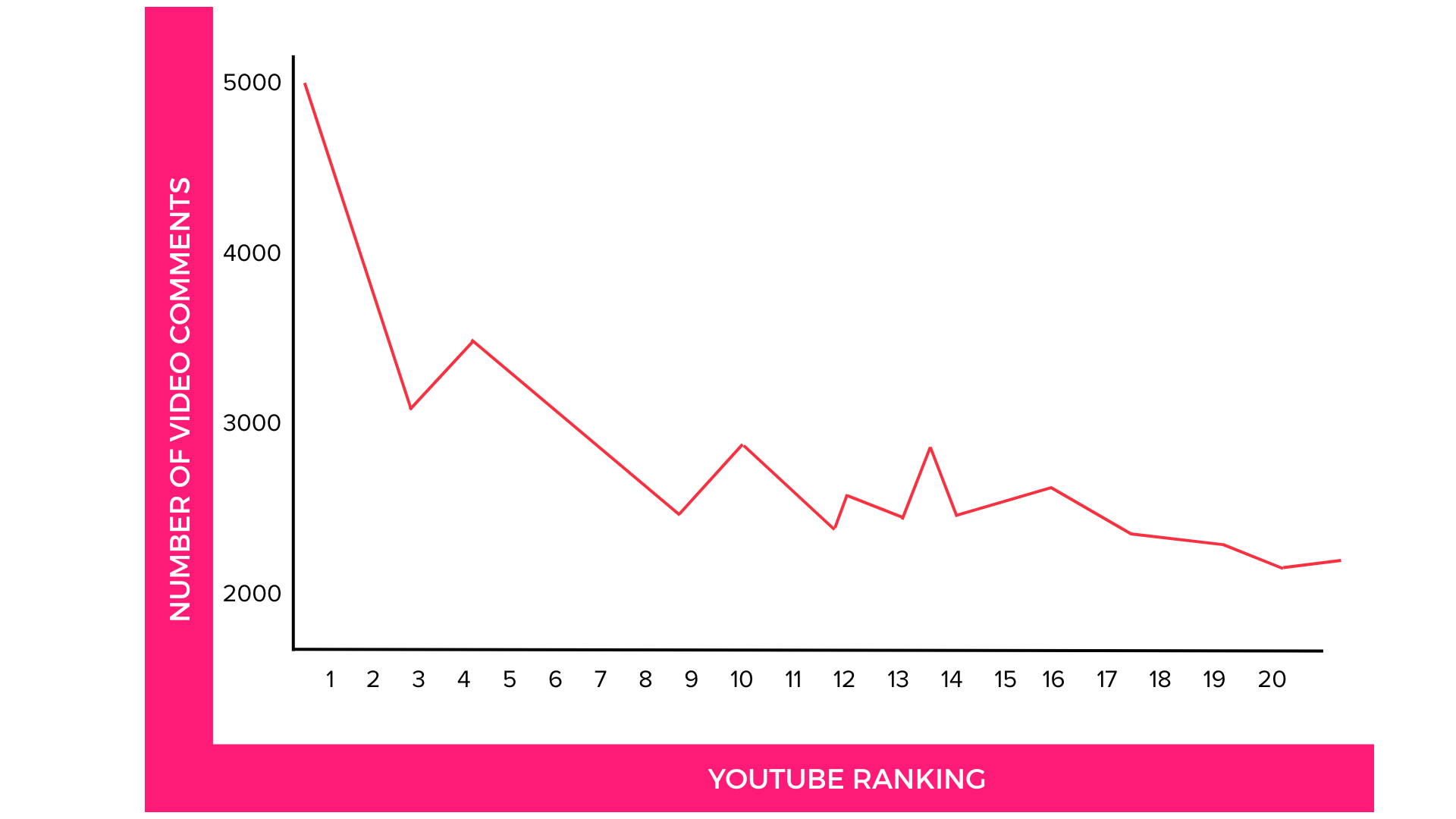
If a video has lots of comments, or someone subscribes to your channel after watching a video, it’s a great signal to YouTube that the content was useful. There is a very strong correlation between number of comments and ranking position, so be sure to ask in your video for people to comment with their thoughts and questions.
Source: Backlinko
Click-through rate from search results is important too. If your video is showing up in search results, but isn’t being clicked on, that’s a negative signal to push your video down the results next time. Use your video thumbnails and video titles to encourage click through and explain at a glance why your video is worth watching.
How to Increase Engagement:
- Ask viewers to like, comment, and subscribe at strategic points in the video.
- Respond to comments to encourage interaction.
- Increase the number of comments by posing questions in the video.
- Create compelling thumbnails and titles to improve CTR from search results.
Do Your Own YouTube Keyword Research
Unlike for Google, YouTube does not provide direct keyword search volume data. However, there are ways to discover high-impact keywords and use these for video creation ideas.
You can also use YouTube’s Analytics to see what search terms your videos showed up for, which can be a great resource to see how you can improve your videos - or as idea generation for future topics.
Effective KWR Techniques:
- Use YouTube Suggested Search to find real user queries. If something shows up in suggested search, it means people have searched for it! So this is a great way to find relevant topics.
- Analyse Traffic Source Reports in YouTube Analytics to see which searches led to your video.
- Take a look at popular competitor videos, and in particular the keyword tags they’ve used - you can do this by using Chrome Extensions such as VidIQ or Keywords Everywhere.
- Check Google SERPs for video results, too. If a video result is present in the regular Google SERP, then this is a good indicator that creating a video for that topic might be even more worthwhile, if you can show up in Google results as well as YouTube’s results with the same content.
- Use Ahrefs’ Content Explorer to find which videos rank for specific terms. If you search using the following text, you can search YouTube specifically to see what videos rank for your desired search term - “site:youtube.com inurl:watch title:topic”
Optimise What You Say in your Videos for SEO
YouTube’s AI scans video transcripts, so verbal content impacts search rankings. If you have a target set of keywords, make sure to say those words within the video. The AI will therefore naturally pull those keywords into the transcript, increasing the relevance of your video for those terms.
Best Practices:
- Naturally incorporate keywords in your speech during the video.
- Upload accurate captions or subtitles, which also helps with accessibility.

Captions help to better describe your video content without the need for audio, and provides an accessible way for those hard of hearing to learn from your video, too.
Improve Click-Through Rate (CTR) from Search Results
Click-through rate is a highly important metric for YouTube’s algorithm, too. Even if you rank in 1st position, if lower-ranked videos get more clicks than you, it’s very likely that your ranking will drop over time.
Ways to Improve CTR:
- Use attention-grabbing thumbnails with bold, contrasting colors.
- Craft compelling titles that create curiosity or promise value.
- A/B test different thumbnails and titles for performance.
Drive External Traffic and Outreach
Don’t rely solely on YouTube Search; external promotion is key. Remember how engagement metrics are important to YouTube rankings? You can only get engagement by having people watch the video in the first place… So, use all of your marketing activities to promote your YouTube content where it makes sense to do so.
Promotion Strategies:
- Embed videos in relevant blog posts to encourage views.
- Share videos across social media and email newsletters.
- Engage in cross-promotion with other YouTube creators.
Optimise Your YouTube Channel
And lastly, your YouTube channel can be optimised too. Make sure to consider the type of keywords that people would be searching for to find a channel that creates content like yours, and optimise for it.
Channel Optimisation Tips:
- Use an SEO-friendly channel name and description. Use keywording where possible (but be human about it!)
- Design a professional cover photo and logo.
- Organise videos into playlists for better user experience.
- Maintain a consistent publishing schedule.
Closing Thoughts
Unlike SEO for Google, YouTube SEO prioritises engagement, watch time, and retention over purely keyword-driven strategies. Consider that unlike a web page, YouTube’s algorithms can only be based on the success of a video - i.e. engagement rates, watch times, likes, comments, subscription rate.
A video is a video, and so engagement data becomes much more valuable in terms of a ranking factor.
To succeed, focus on creating high-quality content that keeps viewers engaged while optimising metadata, keywords, and external promotion strategies. Optimising your metadata and tags alone will not provide success: Ultimately your video content needs to be quality first and foremost.
For help with SEO or Video Production, speak to the Reflect Digital team where our experts can help support with your social media and optimisation needs. Contact Us today.
Contact Us