

How Slow Page Speed Affects Your Website’s Carbon Footprint


We always talk about how slow websites frustrate users, drive up bounce rates, and ultimately hurt revenue. But there’s also another consequence that’s less visible and often overlooked: environmental impact. Web pages that are bloated and inefficient require more data, more processing power, and therefore, more electricity - and where that electricity is largely fueled by fossil energy, that translates directly into more carbon emissions.
When thinking of sustainability, we normally think about it in terms of transportation, recycling, food, or consumer goods. But in a world where approximately 68% of the world’s population (5.5 billion people) are online and where the internet consumes more electricity than the entire United Kingdom and emits more CO2 than the aviation industry, it’s becoming impossible to ignore the environmental impact of our digital endeavours.
Despite its invisible nature, the internet is a major contributor to global carbon emissions, accounting for an estimated 3.7% of global emissions, and with online activity growing rapidly, that figure is expected to increase. Therefore, it’s crucial that we start prioritising sustainability where we can in our online activity, considering our individual impact and how we can reduce our carbon footprints through website optimisation.
In this blog, we’ll explore how slow page speed directly affects your website’s carbon footprint, how to measure it, and how you can reduce your environmental impact without compromising user experience or SEO.
How Slow Websites Harm The Planet
What Is Page Speed and Why It Matters
Page speed refers to how quickly the content on a web page loads and becomes usable for visitors, i.e. the time it takes from clicking a link to being able to see and interact with the page.
A slow-loading site makes for a bad user experience - it frustrates users and leads to higher bounce rates, where people leave before the page even finishes loading. In fact, it was found that 40% of online users will leave a site if it takes more than 3 seconds to load, so page speed is definitely an important factor to consider when optimising your website.
Having a slow page speed is also bad for business. One study by Portent actually found that having a page load time of above 5 seconds will result in roughly half the conversion rate of a fast website.
Moreover, having a slow page speed hurts your rankings on search engines like Google. This is because search engines prioritise faster sites for a better user experience, with particular focus aimed at your website’s Core Web Vitals.
But in addition to all these factors, there’s also a less obvious cost to slow websites: energy consumption.
How Slow Page Speed Impacts The Environment
Every time someone visits your website, data travels across servers, networks, and devices. That journey requires power at every step - every click, scroll, and page load online uses electricity. This means that the more data your site serves - think oversized images, bulky code, and unnecessary scripts - the more processing is required and the more energy it burns. Additionally, if a site is sluggish, users may hit "refresh" or navigate away and return, sending multiple requests and using even more energy in the process. Now, if you were to multiply a single user journey by thousands or millions of visits, the environmental cost adds up quickly, and even small inefficiencies can lead to significant carbon emissions.
We often overlook small digital actions, but even these can be factors affecting your carbon footprint and can contribute to carbon emissions. So that’s why it’s important that we all try to better understand the hidden carbon cost of everyday online activity, from web browsing to sending emails:
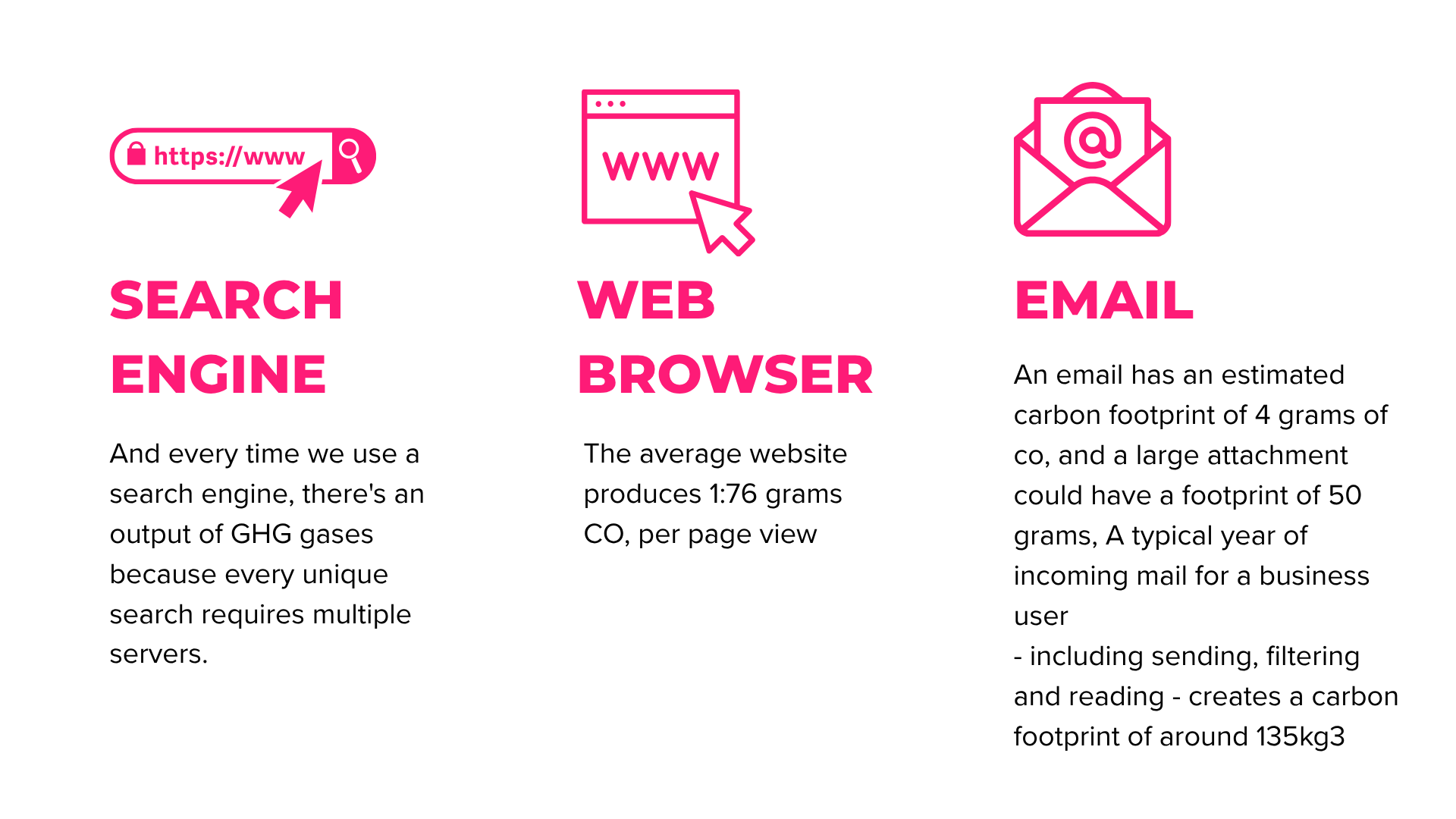
So yes, your website has a carbon footprint.
Slow, heavy websites are especially wasteful, draining electricity and using far more energy than necessary with every page load. Whereas, fast websites use less energy, meaning fewer emissions. So, optimising your website to improve page speed doesn’t just mean happier users and better SEO, but it’s also better for the planet.
Measuring Your Website’s Carbon Footprint
Before you can reduce your website’s carbon footprint, you need to know where you stand. Luckily, nowadays, there are plenty of free online tools and resources that are easy to use and can estimate your site's carbon emissions within just a few seconds, based on factors like data transfer, energy use, and page weight.
To get your report, just plug in your website’s URL and you’ll get an instant snapshot of how sustainable (or not) your site is, along with comparisons to help put things in perspective (like how many trees you'd need to offset your carbon footprint).
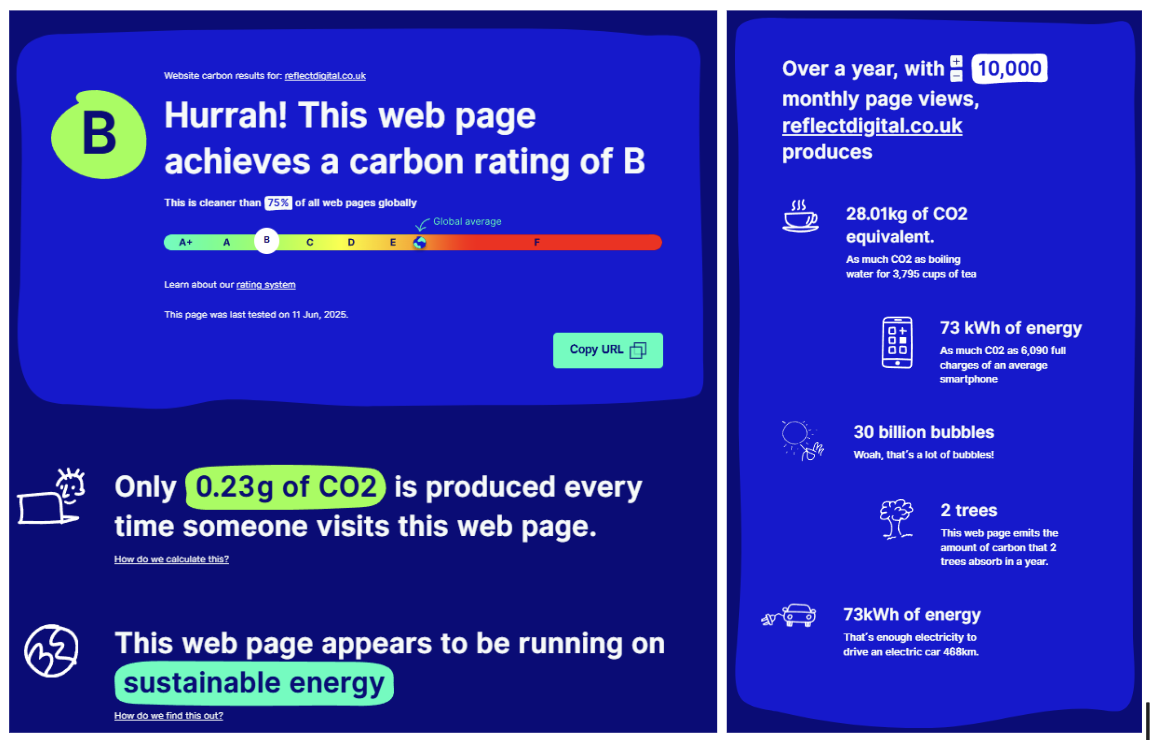
Our top picks for a detailed analysis:
Wholegrain Digital also offers a website carbon badge that you add to the footer of your website:
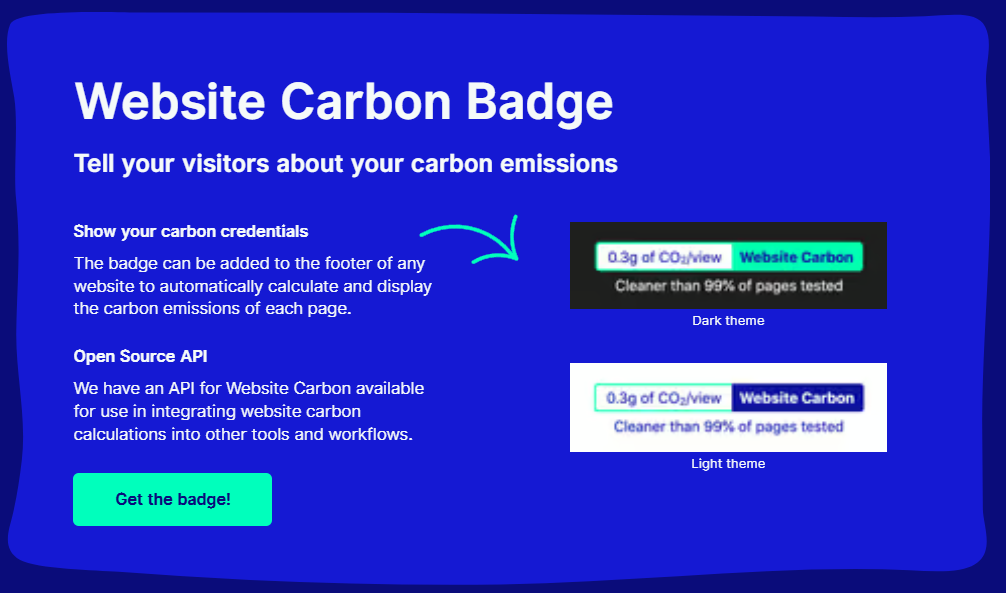
Displaying this badge on your website is a powerful example of the ‘social proof’ human behavioural nudge - by visibly committing to sustainable web design, you not only showcase your values but also help to normalise greener practices and encourage others to follow suit.
A few others tools we recommend:
- Digital Beacon
- Website Emissions - Carbon Calculator
- Karma Metrix - Website Carbon Calculator
Pro tip: Pick one tool and stick with it. Different tools use different methods, so consistency matters when tracking changes over time.
7 Ways To Reduce Your Website’s Carbon Footprint
Here’s a practical breakdown of 7 actionable steps you can take to get started to fix slow page load speed and make your website more sustainable.
#1 Move to a Green Hosting Provider
The internet’s biggest carbon emissions source? Energy-hungry data centres. So, switching to a hosting company powered by renewable energy is one of the most impactful first steps.
Doing this is also a great example of the ‘default effect’ behavioural nudge - by making a green hosting provider your default, you are reducing the friction of making more sustainable choices.
- Check the Green Web Foundation’s hosting directory for vetted providers
#2 Reduce Media Load (Images & Video)
Heavy images and auto-playing videos are some of the worst offenders when it comes to page weight.
So, here are a few changes you can make to combat their environmental impact:
- Compress and convert images to modern formats like WebP
- Lazy load images and videos so they only load when needed
- Turn off autoplay and use lightweight placeholders until interaction
- Host videos externally (e.g. YouTube) where possible to reduce server strain
Learn more about how to optimise images for web using Pixlr and Photoshop.
#3 Tidy Up Your Code
Bloated, unused JavaScript and unminified CSS/HTML increase both load time and energy consumption.
Here’s what you can do about it:
- Minify your code to strip out unnecessary characters
- Remove unused scripts, especially tracking or plugin JS
- Use async/defer loading to keep JavaScript from blocking key content
#4 Use Efficient Fonts & Colours
- When creating and uploading content, there’s no need to load extra files as system fonts are already on users’ devices
- Using darker colour schemes can also save energy on OLED screens (and look sharp too)
#5 Enable Smart Caching & Compression
- Use browser caching to store static files locally for repeat visitors
- Apply GZIP or Brotli compression to shrink file sizes before they leave your server
#6 Leverage a CDN (Content Delivery Network)
A CDN reduces the distance data has to travel by serving content from locations closer to your users - less energy, faster loads.
#7 Cut the Clutter: SEO, Content, and Emails
- Improve SEO to help users find what they need in fewer clicks
- Streamline content - fewer pages, shorter user journeys, better UX
- Be email-conscious - target only engaged users, and keep content lean
Key Takeaways
- The internet has a growing carbon footprint
- Slow, bloated websites use more energy and generate more emissions
- Faster websites are better for users, business, and the environment
- Free tools like Wholegrain Digital’s Website Carbon Calculator and Ecograder help measure your impact
- Simple fixes like image compression, clean code and green hosting go a long way
- You don’t need to overhaul everything at once, but every small step counts
In conclusion, it’s clear that slow page speed and increased carbon emissions are directly linked. Every image compressed and unnecessary request eliminated makes your website faster and protects the planet. Whether you care about user experience, SEO, or sustainability, small changes make a big difference and building a well-optimised website is a win on all fronts.
What You Can Do Today
- Audit your website: use free tools to assess carbon output and speed
- Identify quick wins: compress images, clean up code, and remove unused scripts
- Talk to your team: share what you’ve learned with developers and decision-makers
- Stay informed: subscribe to sustainability resources and keep learning
- Every site visit uses energy, so every optimisation helps cut our carbon footprint
Together we can build a web that’s faster and better, for both people and the planet.
Listen to our podcast on how to save the planet, one website at a time, and read our blog to learn more about what we’re doing to help tackle climate change.
For more information on website optimisation and for more insights from the team, check out our blogs or chat with us today.
Contact Us
MEET THE AUTHOR.
AMELIA MILES
Amelia is our Senior SEO Executive, immersed in the world of digital marketing. She brings enthusiasm and applies creativity and psychological insights to our SEO, content and email marketing strategies. With her natural curiosity and commitment, she contributes to our mission of helping clients achieve their goals and delivering results, and is a positive addition to the team. She also loves getting involved in our Aspiration Digital and BIMA Digital Day events, helping to nurture the future generation of marketers.
More about Amelia