

Are your product or service pages just not leading to conversions? Maybe you’re investing in Paid Media campaigns that aren’t seeing returns? The solution to these problems is often very simple - the content on your page isn’t optimised to tell the story you want to tell.
Storytelling might seem like it doesn’t have a place outside of fiction, but that’s not the case at all. We use it in every conversation, every email, every LinkedIn post - and it should be a large consideration when creating your product and service pages.
Today, we’re going to break down how you can find a story that resonates with your audience when it comes to investing in products and services. We’ll then share structure and language tips to help you tell that story as impactfully as possible. After this, you should be equipped with actionable steps to improve your product and service pages, and optimise campaign effectiveness.
Understand your audience
Ideally, before you get started on writing and designing your product/service pages, you will have a strong understanding of who your audience is and why they need you. What do they care about? What are they anxious about? What do they value? Knowing the answers to these questions will help you personalise your approach, so you can use storytelling to create content they will be more receptive to.
In a B2B context, if your audience cares primarily about growth and revenue, a big focus of your page should be loss aversion and explaining how the product/service you’re selling will help with revenue. In a B2C context where your audience is value for money, you should explain how reliable your product/service is, offer a guarantee, and use social proofing with testimonials to show how much value other people are mining from it.
The key here is having audience data. There may be a difference between your target audience and your actual audience - if you’re tailoring your content to the wrong people, telling the wrong story, you’re creating a disconnect that could be limiting conversions. You need data to back up your assumptions.
This is something our Human Behaviour team can help with - using everything from surveys to social listening, we can collect accurate and useful insights into your audience.
Start at the end: What’s Your CTA?
If you are struggling to figure out what story you should be telling on your product or service page, ask yourself: What do you want users to do once they’ve finished reading?
That’s your call to action. It might be to buy the product, enquire about the service for a personalised quote, or to visit another key page for more information. It will be whatever signifies that the campaign is working.
Once you’ve established this, it’s easier to figure out how to communicate with your audience. You can understand more clearly what they might need to know (or want to know) and how to encourage them to perform that action. Working backwards like this also helps you stay concise - if you find yourself adding things to the page that aren’t directly tied to persuading the user to act, you can remove them.
Many businesses hop straight into writing, and end up with product and service pages either overstuffed with content that could be streamlined (or even removed if it isn’t relevant) or missing a lot of key information. Starting with the CTA automatically helps make the page more impactful, because you know exactly what message you want to convey from the start, and every decision you make is directed towards emphasising that message.
Start Simple - What, How, and Why
Storytelling doesn’t have to be fancy or complicated - on the most basic level, it’s starting with the most simple information and building upon it as you go. For 99.9% of the content we produce, we start here: What, How and Why. By doing this, you ensure every page covers the major points. This is comparable to Simon Sinek’s Golden Circle.
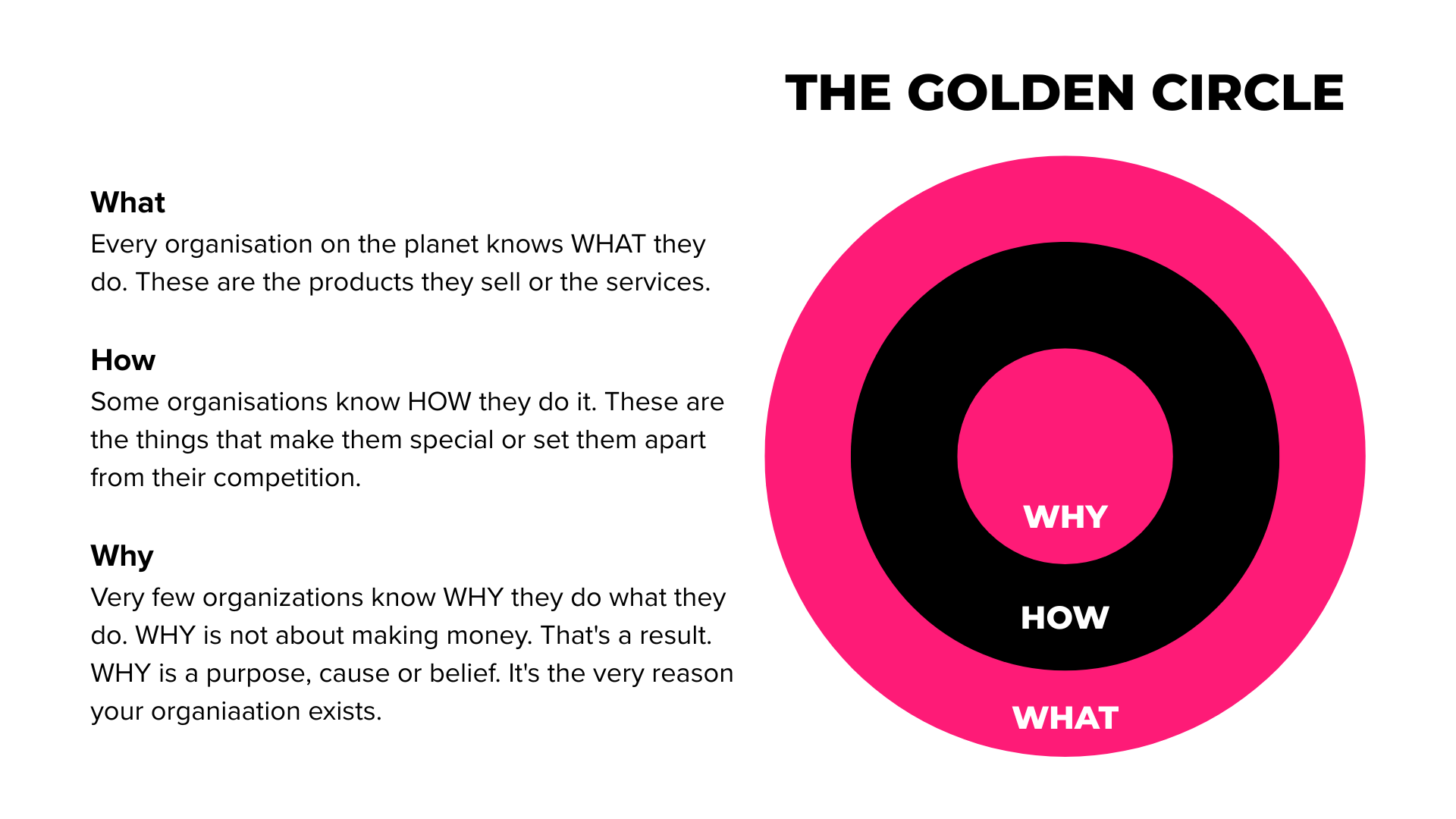
What
A surprising number of businesses forget to explain, in simple language, what their product/service actually is. You can’t take for granted that the user will already be familiar with it. Some will, of course - those people are in the consideration stage of the marketing funnel. But some will still be in the awareness stage, and need to be accounted for so they’re not alienated.
This will be particularly crucial for tech companies, law firms, and similar businesses where jargon and industry-specific terminology could confuse people from the start. If you want an example of the whole structure in action, visit the Conveyancing & Residential Services page for law firm Whitehead Monckton.
How
This is where you can get more technical and specific. Explain, as concisely as possible, how your product/service works. What does it do? What does it offer that competitors are not offering? Breaking down your service like this helps to eradicate Ambiguity Aversion - the user knows exactly what they’re signing up for, which is far more trustworthy than vague assertions that it’s the best you could buy.
This is particularly helpful to users who are in the consideration stage - at this point, they’ve done plenty of research and want to see which product/service they’re looking at aligns best with their expectations.
Why
The final stage is to explain why your company is different - what unique selling points can you use to foster an emotional connection with your users? Decision-making is fundamentally emotional, so taking every opportunity to show the user that your values align with theirs, and that their wants and needs are your top priority, is how you can get people converting.
This is the chance to make yourselves unique and memorable, especially in competitive industries. For example, our client Nido Living offers premium student accommodation all across Europe. They stand out because they are dedicated to helping their students build a community around them, with regular events and many shared social spaces across their residences. Showing students that they care in this way is a massive selling point for the brand.
Experiment with different storytelling techniques
Once you have your basics in place (the what, how and why) you can start to play with different structures that might help you convey that information in more impactful ways. Here are just a few of our favourite storytelling techniques:
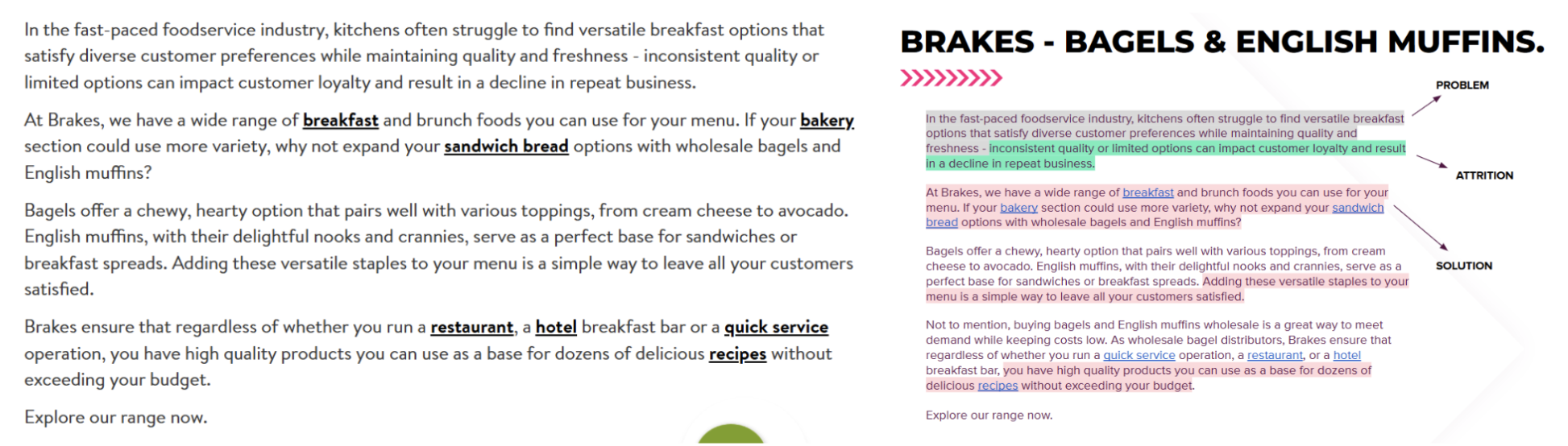
Problem, Attrition, Solution (PAS)
This is a great place to start your page if you’re struggling to hook users right away. It directly addresses their pain points - wants, needs, concerns, etc - and teases how the product/service will solve them.
Problem: What the user wants, needs, is worried about, etc.
Attrition: How ignoring that problem might lead to larger consequences.
Solution: How the product/service can help.
Here’s an example of how the PAS structure can make writing short pieces of text easier. Our client Brakes uses a 150-200 word snippet of text on each product page, so we use PAS to optimise them:
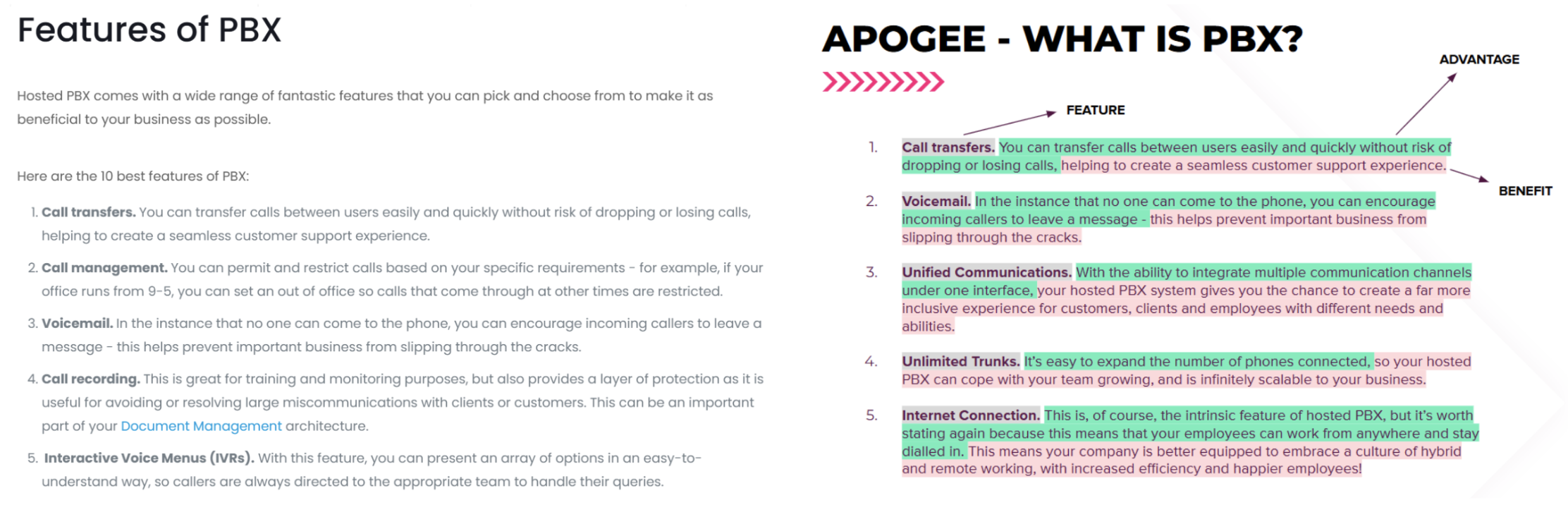
Features, Advantages, Benefits (FAB)
Struggling to demonstrate value? You can elevate a simple bullet-point list of benefits by using this storytelling structure, which is perfect for more complex products.
Features: Lay out the actual components of the product clearly.
Advantages: Why should the user care about this feature? Phrases like, “This is useful because…” can help.
Benefits: How will it help the user long term?
Here’s an example of the FAB structure in practice, in an Apogee blog post about PBX:
Pascalle Bergman’s “Storyselling”
For BrightonSEO’s September 2023 event, public speaker Pascalle Bergman discussed the power of storytelling in shaping your website content. The structure she proposed is rooted in human behavioural principles and focuses on building an emotional connection with users and engaging the user’s imagination. Here’s a simplified version for our purposes:
Build the World: Set the scene - explain what the industry the client is in is currently like.
Problem: Explain the main problems the user has to solve.
Solution: Lay out how the user can fix their problems with the product/service on offer.
The New World: Illustrate the “new world” the user could take advantage of now that their problems are solved. This is valuable for contextual thinkers, who are most keen to know what kind of impact the product/service will have on their lives (how much happier, healthier, safer or richer they will be).
We recommend you watch the full talk to learn more.
Experiment with content length
The last thing you need to know before you go off to work on your product/service pages is that longer content is not always better.
If you tell a user everything they need to know about your product or service in just a few paragraphs, then that’s all you need! Unnecessary details really impact the success of a story, confusing users and making it harder for them to figure out what the product/service is and what you want them to do.
The amount of detail you need is going to vary from business to business. Sometimes users will need lots and lots of contextual information, and sometimes they’ll just need some key trust signals. One way to figure out what works best for your purposes is to consult SEO experts, who will evaluate competitor content and see what you need to do to outrank them.
But if you believe your product/service pages are too text-heavy, practice synthesising the information. Re-write it in half as many words, and then a quarter. This will help you pick out the key points and figure out what can be removed.
Key Takeaways
To conclude, if you want to use storytelling to supercharge your product/service pages, this is where to start:
- Get to know your audience. Nothing is going to resonate properly if you don’t know who you’re writing for - once you understand your audience’s pain points, it will be far easier to figure out how to engage them and establish that emotional connection.
- Start simple, and build up from there. The most surefire way to overcomplicate things is to just start writing. Instead, draft out your key points (what, how, why) and then start incorporating other features like FAQs, testimonials, case studies, etc.
- Test and learn! Having fun with different storytelling techniques and content lengths are the best way to figure out what’s working - keep one eye on the data, and use that to make more impact in the future.
And at the end of the day, remember that you know your product or service best, so storytelling is just you finding the best way to celebrate it!
Want to read more on how storytelling should be at the centre of your marketing strategy? Here are more resources:
- The Power of Storytelling in Paid Media: Engaging Users through Narratives
- The Role of Storytelling in Influencing Consumer Behaviour
- Simple Human Behaviour Tactics to Get the Most Success From a Video
If you’re already convinced, check out our Content Writing services to see how we can help take your webpages, emails, social media posts, and more to the next level.
Contact Us