

Navigating the Future of Search in the Home & Lifestyle Sector


At Reflect Digital, we spend a lot of time looking at the data in the new era of search behaviour, and the future of search in the Home & Lifestyle industry has hit a point of no return, with the findings from our Q1 2026 SearchPulse report taking even us by surprise.
For the Home & Lifestyle industry, the traditional, linear marketing funnel has collapsed into what we call the "decision gate".
The days of aimless web browsing are numbered as we witness a fundamental shift where search is no longer just about finding a product, but about finding the immediate confidence to complete a task.
If your brand is still treating search as a single Google text box, you are leaking revenue across the board. Here is what you need to know to adapt to the new rules of engagement and win the fractured home improvement journey.
The Instructional Imperative (Show, Don't Just Tell)
Our world is overloaded with information, and for DIY consumers, simplicity has become the ultimate competitive advantage. The traditional boundaries between a retailer’s website, a YouTube tutorial, and an AI step-by-step breakdown are effectively disappearing.
Customers now demand actionable clarity over generic brand marketing. In fact, a significant 45% of respondents cited "easy to understand/follow" instructions as the single most important factor when choosing a DIY brand or product. Furthermore, 32% of users find ‘Step-by-step visual guides’ to be the most helpful digital feature available. Tapping into Commitment Bias, consumers are actively seeking to reduce the perceived effort or risk before committing to a purchase or project, whilst also craving Cognitive Ease, because ‘showing’ them not only reinforces that confidence to buy but reduces the mental friction of starting a project.
A brand that does this particularly well is IKEA. Across its social channels, IKEA regularly shares short, visually led reels that break down everyday home improvements into simple, easy-to-follow steps. Whether it’s organising a kitchen drawer, styling a bedside table, or refreshing a small living space, the content typically follows a clear structure: a quick hook, a sequence of visual steps, and a final reveal. By relying on their own and User Generated Content, clean visuals, IKEA makes the content easy to understand even without sound, while also creating highly saveable and shareable inspiration for homeowners, all whilst showcasing their products.
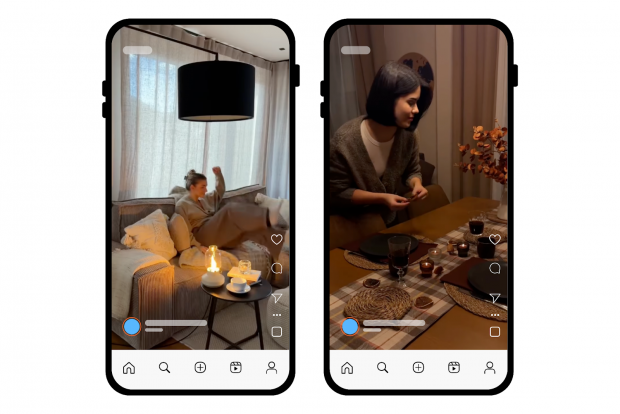
The instruction manual has moved from the back of the box to the very centre of the search experience. Consumers are using tutorials as a pre-purchase confidence check; they want to see exactly how a task is done or what something looks like before committing to buy.
Retailers & Marketplaces are the New Search Engines
While social media is brilliant for building intent and discovery, it becomes less important as people move closer to the purchase stage. Instead, consumers are turning directly to retail platforms.
Our data shows a notable trend towards specialist ‘destination search’, with 38% of consumers consulting retailers like IKEA or B&Q directly and 23% using Amazon as a decision-making platform.
For the 35+ demographic in particular, Amazon and B&Q act as a practical reality-check search, functioning as a filter for possibilities based on affordability and speed of delivery. If you aren't treating these platforms as vital search engines in their own right, you are missing out on highly motivated, bottom-of-the-funnel buyers.
AI as the Ultimate DIY Project Manager
The "buy it for me" moment is arriving faster than most marketing teams can update their roadmaps, where AI is rapidly moving beyond a simple chat and into the role of a functional project manager.
For the under-45 segment, AI is an emerging DIY research tool, with price evaluation as its most appealing use case. We found that nearly 30% of users are now turning to AI tools specifically to compare products or prices, and 26% are using them to decipher complex DIY instructions or techniques.
However, a digital divide remains. While the most digitally savvy users are deeply embedded in AI tools like ChatGPT and Perplexity, over a third of respondents, largely the 55+ segment, remain resistant to using AI for home improvements, highlighting the need for a multi-layered approach.
The End of the 'One-Size-Fits-All' Strategy
Search has completely fractured into distinct personas driven by underlying behavioural drivers. Your audience is navigating a "messy middle" during the research phase.
For the under-35s, inspiration is highly visual and social-led, with, obviously, 54% of 18-24s now using TikTok as a regular search tool, officially surpassing Google within that demographic. Meanwhile, Pinterest maintains its unshakable niche, outperforming all other social media platforms specifically for DIY and home renovation inspiration.
This differentiation reflects specific psychological drivers, where we see younger segments using platforms like TikTok and Instagram being driven by Social Proof (seeing peers complete a project) and a strong Visual Bias, demanding quick, demonstrable results. Meanwhile, the emerging reliance on AI for research appeals to Automation Bias, where users willingly trust a system to simplify complex information and, in effect, outsource their cognitive effort entirely.
Key Takeaways
To ensure your brand stays visible and captures the purchase at the new "decision gate", you need to pivot your strategy:
-
Audit your instructional content: Shift from pure lifestyle aspiration to instructional clarity. Ensure you have high-quality, step-by-step visual guides that build immediate pre-purchase confidence.
-
Optimise the marketplace: Treat Amazon, IKEA, and B&Q as core search engines. Ensure your retail listings are optimised for price transparency, delivery speed, and simplicity.
-
Prepare for the automated advocate: Structure your website data clearly so that AI models (LLMs) can easily read, process, and recommend your products to high-income Digital Explorers who are delegating their research.
-
Bridge the social commerce loop: For younger segments treating TikTok and Instagram as search engines, ensure a seamless path from inspiration to checkout by linking off to retailers or using in-app shopping features.
Are you ready for the future of search? If you want to dive deeper into these insights and discover how your brand can stay ahead of the curve, download the full SearchPulse Q1 2026 Home & Lifestyle Report, or get in touch with our expert team at Reflect Digital to chat about supercharging your search strategy today.
Contact Us
MEET THE AUTHOR.
LUCY TODD
Lucy works alongside the Marketing Director and Marketing Coordinator to oversee growth and delivery of the agency's marketing strategy. Overseeing and managing various channels including CRM, Content and Social, Lucy contributes to the agency's ongoing strategy through idea generation, research, campaign creation & activation, and project management. Alongside contributing to the agency's continuous growth, Lucy supports the agency's events including Roundtables, and contributes to the thought leadership programme.
More about Lucy