
System 1 and System 2 Thinking Influence Modern Search Behaviour


Have you ever opened a search tab just to settle a quick debate about a movie release date? Now, contrast that with the last time you searched for a new laptop, a holiday destination, or a medical symptom.
The differences between these two search sessions aren’t just about the keywords you typed; they reflect two fundamentally different ways the human brain processes information.
In our latest SearchPulse Q2 2026 Report, we uncovered a fascinating duality in modern search behaviour. Users generally operate in one of two modes: finding answers instantly or painstakingly building confidence for major decisions. For finding out about the latest news, more than half of users (54%) want either an answer as quickly as possible or a short answer with supporting information, but for tasks like booking and planning a holiday, this drops to only 25%. Most users (34%) are happy to find the most verified answer for their holidays even if it takes longer to do so.
To understand why people search this way, we have to look at a classic psychological framework introduced by Nobel laureate Daniel Kahneman: System 1 and System 2 thinking.
The Two Modes of the Human Mind
In his novel Thinking, Fast and Slow, Kahneman described our thought processes as being driven by two distinct systems:
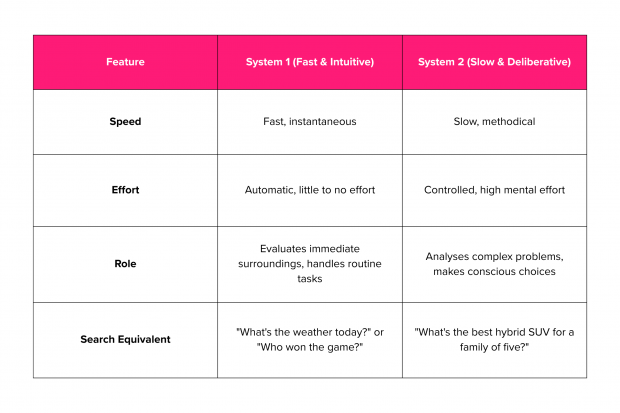
Understanding how these two systems interact is the secret to understanding how search behaviour is evolving, especially with the rise of AI search and social discovery.
System 1 Search: The Rise of the Instant Answer
When a user is in a System 1 mindset, they are looking for the path of least resistance. They want low-stakes information: learning quick facts, checking the latest news, or looking up a definition. Because the stakes are low, the cognitive effort should be too.So how can we design content for users engaged in System 1 thinking? By applying the principle of Friction Reduction, a key behavioural nudge designed to make the path of least resistance the default, we can strip away unnecessary obstacles. Users in a System 1 state aren't just lazy; they are energy-efficient and saving their cognitive resources for information that matter more. By simplifying your UI and content structure, you aren't just 'optimising for SEO,' you are respecting the user’s cognitive load.
This is where AI Overviews and direct answers shine.
For low-stakes research like learning facts or the latest news, AI overviews are often entirely enough to satisfy a user's immediate information needs. - SearchPulse Q2 2026 by Relfect Digital
When a user triggers a System 1 search, they don't necessarily want to click through five different websites, read introductory paragraphs, and dodge pop-up ads. They want a reliable, consolidated answer right at the top of the page. If the AI overview delivers that answer instantly, the search journey is a success. The brain conserves energy and moves on.
System 2 Search: The Quest for Reassurance and Confidence
But AI summaries only tell half the story. When the stakes get higher, involving hard-earned money, health, or major life experiences, the human brain shifts gears into System 2 thinking.
System 2 is cautious, sceptical, and thorough. If you are booking a £5,000 family holiday or deciding on a career path, an AI-generated bulleted list isn't going to cut it. You don't just want an answer; you want reassurance that you are making the right choice.
System 2 Search Journey

Our Q2 data highlights that for high-stakes research involving purchases and experiences, people are more than willing to spend time exploring diverse sources. They want to:
-
Cross-reference information by checking multiple blogs, forums, and official sites to ensure consensus.
-
Seek out authentic experiences by reading reviews and testimonials from real people.
-
Build an emotional safety net by taking the time to ensure they won't regret their final decision.
For these searches, a long journey isn't a sign of a poor search experience. It’s a necessary psychological process where every step helps build people’s trust and confidence in the answer they will get.
This is reflected in how people are interacting with AI-powered search. 40% of users deliberately bypass AI Overviews to continue exploring standard web results, while 45% of 18–24-year-olds actively click through to verify AI-generated information using the original sources. Rather than replacing traditional search, AI is changing its role. Organic content has become a critical point of verification, making it more important than ever for brands to create credible, authoritative content that builds confidence at the moment when users seek reassurance.
What This Means for Content Creators and Marketers
The takeaway from our Q2 2026 report is clear: one size does not fit all in the modern search ecosystem.
-
Structure content for quick recognition by AI and humans: If your content answers simple, factual "What is" or "When is" questions, ensure it is structured cleanly, using schema markup and clear headings, so AI models can easily parse and credit your information in instant overviews that can capture people engaging in System 1 thinking.
-
Build deep-dive hubs for high-stakes keywords: If you are selling a product, offering a service, or guiding a major life choice, don't just provide surface-level answers. Create comprehensive, deeply researched, and highly authoritative content. Give the System 2 searcher the breadcrumbs, reviews, and data points they need to feel confident choosing you.
Ultimately, search is no longer just a tool for retrieving data; it is a reflection of human psychology. By structuring our digital experiences to satisfy human motivations, including both the fast-thinking factual hunter and the slow-thinking deliberate researcher, we can meet users exactly where their brains want them to be.
Want more insights into how user behaviour is shifting this year? Download our SearchPulse reports now.
Contact Us
MEET THE AUTHOR.
LUCY TODD
Lucy works alongside the Marketing Director and Marketing Coordinator to oversee growth and delivery of the agency's marketing strategy. Overseeing and managing various channels including CRM, Content and Social, Lucy contributes to the agency's ongoing strategy through idea generation, research, campaign creation & activation, and project management. Alongside contributing to the agency's continuous growth, Lucy supports the agency's events including Roundtables, and contributes to the thought leadership programme.
More about Lucy