
LLM content optimisation is the process of structuring your content so that AI-powered tools like ChatGPT, Perplexity, and Google's AI Mode can easily interpret, trust, and cite it in their responses.


How to Optimise Content for LLM Interpretation
The way people search for information is transforming. Where once a marketer's focus was purely on ranking in Google's blue links, today's consumer is increasingly turning to AI-powered tools such as ChatGPT, Perplexity, and Google's AI Mode to get direct, synthesised answers to their questions.
This shift means the content you publish isn't just being read by humans and crawled by traditional search bots. It's being interpreted, processed, and reproduced by Large Language Models (LLMs). And if your content isn't structured in a way that LLMs can understand, trust, and cite, you risk becoming invisible in the very channels your audience is migrating towards.
So, what does it actually take to optimise your content for LLM interpretation?
Let's explore.
What is an LLM?
A Large Language Model (LLM) is an advanced AI system trained on vast amounts of text data. Think of it as an incredibly well-read researcher who has ingested billions of web pages, articles, reviews, and forums, and can instantly synthesise relevant answers based on a given prompt. Tools like ChatGPT, Google Gemini, and Perplexity AI are all powered by LLMs, and as we explore in our piece on the future of AI search, their influence on how consumers discover brands is only growing.
What is LLM Interpretation?
LLM interpretation refers to how an AI model reads, processes, and decides whether to use your content when generating a response. Unlike a traditional search engine that ranks pages based on links and keywords, LLMs assess content based on clarity, structure, authority, and trustworthiness. They don't just find your content, they judge it.
Why Does This Matter for Marketers?
If an LLM can't clearly interpret your content, it won't cite it. If it can't trust your content, it won't recommend your brand. As AI search adoption grows, the brands that understand how to speak to LLMs will achieve meaningful impact where their competitors are still catching up. Understanding your visibility across AI platforms starts with tracking the right data, something we cover in depth in our LLM tracking guide.
How LLMs Decide What Content to Use
Understanding the mechanics behind LLM content selection is the foundation of any optimisation strategy. If you want to capitalise on the shift towards AI search, you first need to understand how these models decide what content is worth using.
Pre-Training Preferences
During their training phase, LLMs ingest enormous volumes of internet data, but not all content is treated equally. Developers actively filter out low-quality, unverifiable, or untrustworthy sources. Authoritative content, such as well-sourced articles, expert commentary, and encyclopaedic references, is significantly preferred. In short, LLMs are trained to trust the sources that humans trust. This is why building topical authority across your content ecosystem is one of the most valuable long-term investments a marketer can make.
Retrieval-Augmented Generation (RAG)
Many modern LLMs use a process called Retrieval-Augmented Generation (RAG), which allows them to pull in real-time, relevant external content before generating a response. This means your content can be discovered and cited dynamically, but only if it signals the right authority and relevance markers.
E-E-A-T Signals
Google's E-E-A-T framework, which stands for Experience, Expertise, Authoritativeness, and Trustworthiness, isn't just a traditional SEO concept. LLMs apply similar logic when evaluating content quality. Pages that demonstrate genuine first-hand experience, cite credible sources, name qualified authors, and maintain factual accuracy are far more likely to be surfaced in AI-generated responses. If you're new to E-E-A-T or want to strengthen your understanding, our dedicated guide on what E-E-A-T means is a great place to start.
Core Strategies to Optimise Content for LLM Interpretation
1. Structure Your Content for Clarity and Hierarchy
LLMs process content much like an expert researcher skims a document, looking for clear signals of what's important, what's being defined, and how ideas relate to one another. As we explore in our blog on why headings should be optimised for people, not just SEO, the way you structure your content has a direct impact on both human readability and how AI systems interpret your pages.
-
Use descriptive headings and subheadings (H1, H2, H3) that mirror the language your audience uses when searching
-
Lead with the most important information — don't bury your key insight three paragraphs in
-
Write short, focused paragraphs, as one idea per paragraph makes content far easier for LLMs to extract and cite accurately
-
Use Q&A formats, since LLM interactions are often question-based, and structuring content around common questions significantly increases the chances of being cited in a direct answer
This is the digital marketing equivalent of the anchoring effect. Present your most credible, well-structured content upfront, and the LLM's assessment of your entire page is shaped by that first impression. To understand more about how human behaviour influences the way people and AI systems process information, it's worth exploring the psychological principles that underpin good content decisions.
2. Demonstrate E-E-A-T Through Every Element of the Page
Authority isn't claimed, it's demonstrated. LLMs are effectively "citation machines," and they prefer content that signals genuine expertise and trustworthiness at every level. Our guide on what E-E-A-T means breaks down exactly how to apply this framework across your content, and it's just as relevant for AI search as it is for traditional rankings.
Showcase Authorship and Credentials
Named authors, detailed bios, and clear credentials signal genuine authority to both readers and LLMs. Content attributed to a real, qualified person will always outperform content from a faceless brand voice.
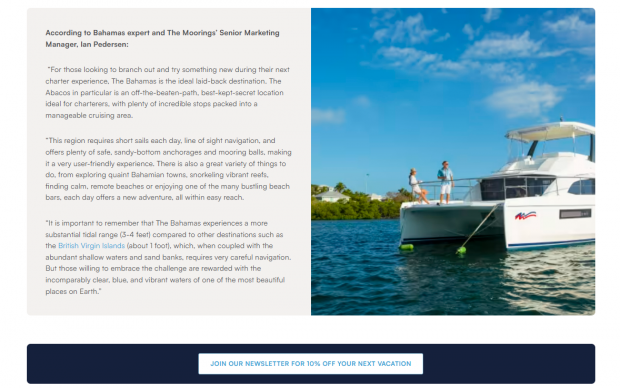
The Moorings is a strong example of this done well. Their Abacos page features named expert commentary from Senior Marketing Manager, Ian Pedersen, giving both the reader and the LLM a credible, identifiable source to trust.
Incorporate original research and first-party data
Statistics, proprietary insights, and first-hand data are powerful trust signals. Original research is especially valuable to LLMs, which act as “citation machines” and prioritise verifiable data and evidence.
According to the SearchPulse Q1 2026 report, content featuring original research can achieve 30–40% higher visibility in LLM responses, highlighting the need to go beyond generic content.
For marketers, this means investing in experience-led content that AI cannot easily replicate, positioning your brand as a trusted, citable source.
Use expert quotes and real-world experience
First person commentary from named experts adds a layer of authenticity that generic content simply cannot replicate. This is the authority bias in action. Consumers and AI systems alike place greater weight on information from credible, identifiable sources, and as we discuss in our piece on teaching LLMs to trust you, building that trust is a long-term strategy that compounds over time.
Leverage third-party validation
Reviews from platforms like Google Reviews, Trustpilot, and TripAdvisor serve as powerful external trust signals. LLMs actively ingest review data as part of how they understand brand reputation, making third-party validation one of the most underutilised levers in an SEO and AI optimisation strategy.
3. Use Structured Components That LLMs Can Easily Parse
The structure and format of your landing pages and content aren't just UX decisions; they're LLM optimisation decisions. The way you organise information on a page directly influences whether an AI system can extract, trust, and cite it.
A strong real-world example of this in action is The Moorings' Abacos destination page. Rather than presenting a single wall of text, the page leverages a series of structured content components that serve both the human reader and the AI systems interpreting the page:
-
At a Glance — a short, digestible overview that immediately establishes context
-
Expert Quotes — direct, named commentary from The Moorings' own Senior Marketing Manager, Ian Pedersen
-
FAQs — structured Q&A covering key search queries like "What are the sailing conditions in The Abacos like?"
-
Experience Component — first-hand descriptions grounded in genuine knowledge of the destination
-
Testimonials Component — real customer voices providing social proof
Each of these components serves a dual purpose: enhancing the human user's journey from awareness to purchase, whilst simultaneously providing LLMs with clearly labelled, well-structured, trustworthy content to draw from. This kind of component-led approach is central to how we think about AI search optimisation at Reflect Digital. The result is a page that doesn't just rank, it gets cited.
4. Write Self-Contained, Chunk-Friendly Content
LLMs often process content in discrete chunks, particularly in RAG-powered systems. A paragraph that makes perfect sense in the context of the full page may lose all meaning when extracted in isolation. Understanding how AI search systems retrieve and process content is essential for any marketer looking to future-proof their content strategy.
To future-proof your content:
-
Make every section independently meaningful and avoid relying on earlier paragraphs to explain the current one
-
Repeat key context where needed, as it's better to restate a key term than to assume the LLM carries it forward
-
Align paragraph breaks with topic shifts and avoid switching between ideas mid-paragraph
This mirrors the chunking principle in behavioural psychology. As we explore in our resource on applying human behaviour in marketing, humans and AI systems alike recall and process information more effectively when it's delivered in digestible, clearly defined units.
5. Influence the Sources LLMs Use About Your Brand
One of the most overlooked aspects of LLM optimisation is that your brand's portrayal in AI responses isn't determined solely by your own content. LLMs pull from third-party articles, review platforms, industry reports, and social platforms, and the language used in those sources often appears word-for-word in AI-generated responses. We explore this in detail in our guide on what LLM tracking can teach us about AI search performance.
This is where digital PR becomes a critical lever. By identifying the external sources an LLM is using to describe your brand, you can:
-
Reach out to update inaccurate or outdated content, and mentioning that the article is being actively used by LLMs can underscore its importance to the publisher
-
Proactively seed positive narratives on high-authority platforms like Reddit, Quora, and Wikipedia, all of which are known to be heavily ingested by LLMs
-
Pursue digital PR coverage on reputable publications, as brand mentions across multiple trusted sources build the kind of consensus that LLMs are designed to recognise and reward
As we highlight in our piece on the future of topical authority, the brands that actively shape their external narrative will be the ones that earn consistent visibility in AI-generated responses.
6. Ensure AI Crawlers Can Access Your Content
All of the above is rendered meaningless if LLMs can't actually reach your content. It sounds obvious, but many brands are inadvertently blocking AI crawlers through their robots.txt settings, quietly undermining their entire SEO and AI search strategy without realising it.
-
Audit your robots.txt to ensure you're not unintentionally blocking AI bots
-
Use tools like the AI Bot Access Analyzer to verify your site's discoverability
-
Keep high-value pages updated, as LLMs may draw on outdated cached information if pages aren't refreshed regularly
What LLM-Optimised Content Actually Looks Like in Practice
|
CONTENT THAT GETS OVERLOOKED |
CONTENT THAT GETS CITED |
|
Generic, unattributed text |
Named authors with clear credentials |
|
Vague claims with no data |
Stats, original research, cited sources |
|
Long, unbroken paragraphs |
Short, structured, self-contained sections |
|
Passive, ambiguous language |
Clear, direct, active statements |
|
No FAQs or Q&A structure |
Explicit answers to common queries |
|
Blocked by robots.txt |
Fully accessible to AI crawlers |
|
Relies on outdated third-party coverage |
Proactively managed external narrative |
Key Takeaways
Optimising content for LLM interpretation isn't a single tactic; it's a connected strategy that spans your own content, your technical setup, and the wider ecosystem of sources that shape how AI describes your brand. Here's what to take forward:
-
Structure is everything. Clear headings, concise paragraphs, and Q&A formats make it significantly easier for LLMs to extract, trust, and cite your content. Read more on optimising headings for people, not just SEO.
-
Authority must be demonstrated, not assumed. Named authors, original data, expert quotes, and third-party validation are the signals LLMs look for. Start with our guide on E-E-A-T in SEO.
-
Components matter. FAQs, expert commentary, testimonials, and at-a-glance summaries serve both your human audience and the AI systems interpreting your content.
-
Your brand's story lives beyond your website. The external sources LLMs use to describe you are just as important as your own pages. LLM tracking is the first step to taking control.
-
Access is non-negotiable. If AI crawlers can’t reach your content, none of the above matters. If your pages aren’t accessible, indexable, and structured clearly, they won’t be retrieved or cited in AI-generated responses.
-
This is an evolving landscape. AI search requires ongoing analysis and adaptation. The brands investing in human-first content today will be best positioned tomorrow.
The brands that succeed in AI search aren't necessarily the biggest. They're the ones that understand how LLMs think and craft content that genuinely earns their trust.
If you'd like to understand how your content is performing in AI search, our team is here to help.
Contact UsFREQUENTLY ASKED QUESTIONS
You can monitor your brand's visibility across AI platforms by tracking key metrics such as mentions, citations, sentiment, and rank. These insights show you where your content is performing well and where gaps exist.
Yes. LLMs apply similar logic to Google's E-E-A-T framework when evaluating content quality. Pages with named authors, original data, and credible sources are far more likely to be surfaced in AI-generated responses.
Traditional SEO focuses on ranking in search engine results pages. AI search goes further, with LLMs synthesising answers from multiple sources and directly citing the most authoritative and trustworthy content in their responses.
Start by auditing your existing content for clarity, structure, and authorship signals. Then identify which external sources LLMs are using to describe your brand and take steps to proactively manage that narrative.

MEET THE AUTHOR.
NARAYAN GOSWAMI
Narayan supports the SEO team at Reflect Digital by executing key strategies that drive performance for clients. He is passionate about delivering high-quality content, on-page optimisations, and technical SEO solutions that enhance website performance and improve search visibility. Narayan thrives on analysing data through tools like SEMrush, Google Analytics, and Google Search Console to uncover opportunities for growth.
He aims to continuously develop his skills while contributing to Reflect Digital's mission of achieving outstanding results for clients. Narayan enjoys being part of a collaborative environment where innovation and excellence are celebrated, and personal and professional growth are encouraged.
More about Narayan