Beyond the Search Bar: Black Friday Shopping Starts Long Before Google



Social media has fundamentally changed how we navigate major annual events. The modern Black Friday path
to purchase can begin long before a shopper types a product name into Google - nowadays, it often begins in the scroll.
Almost half (49.3%) of adult internet users in the UK say they use social media to find information about products. And according to recent industry data, the most popular social networks for uncovering Black Friday offers are Facebook (30%), Instagram (30%), and TikTok (17%).
This means the Black Friday journey doesn't necessarily start with a search query. It can start with discovery.
Why Shoppers Are Using Social to Discover Products and Deals
Social search is changing Black Friday shopping by shifting consumer behaviour from intent-driven keyword queries to discovery-led, visual exploration. Rather than starting on Google with a specific product in mind, shoppers use algorithmic feeds on TikTok and Instagram to uncover deals, evaluate peer proof, and build familiarity weeks before purchasing.
The average person will spend almost 3 hours a day on social media platforms, whether that be passive scrolling, messaging friends, or engaging with creators to uncover the latest retail trends and brand promotions. These platforms merge entertainment, real-time social proof, and personalised algorithms.
This shift from passive entertainment to active commercial discovery isn't accidental. It is driven by a fundamental change in how we trust information online. Traditional search engines present us with pages of SEO-optimised links and related paid advertisements. Social media, however, offers something far more valuable to the modern consumer: authentic, real-time social proof. Short-form UGC and native video content on platforms like TikTok feel inherently more authentic. While a Google search targets users ready to solve an immediate problem or buy right away, social ads, especially video, seamlessly integrate into a user's feed, making them feel like natural content rather than intrusive marketing.
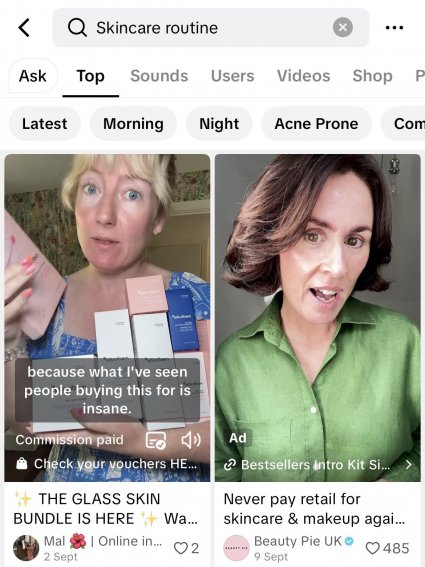
During the TikTok 2025 Black Friday/Cyber Monday period, the platform recorded a massive 50% year-on-year growth in sales, alongside a 28% surge in unique shoppers. At its absolute peak on Black Friday itself, an astonishing 27 items were sold every single second on the platform. This explosive growth highlights a critical behavioural angle that every modern marketer needs to understand: discovery happens long before intent.
Behavioural science insight: Not every Black Friday shopper opens their phone knowing what they want to buy. Repeated exposure to a product, brand, or creator recommendation can build familiarity before a user ever demonstrates traditional search intent. By the time they Google the product, the brand may already feel familiar.
TikTok itself describes Black Friday as a moment where “discovery and shopping collide”. Rather than treating Black Friday as a single-day event, the platform recommends building campaign momentum weeks in advance. By using paid media to fuel the mere exposure effect early, brands can warm up audiences, plant the seed of discovery, and dictate exactly what ends up on those holiday shopping lists long before the first search query is ever typed.
The Role of Creators in Influencing Black Friday Purchases
Black Friday puts brands into a particularly noisy environment. When every competitor is shouting “20% OFF”, “BIGGEST SALE OF THE YEAR” or “DON'T MISS OUT”, the discount itself can become less distinctive.
It is impossible to talk about social discovery without looking at the creators driving it. Creators can provide something a promotional banner can't: context. Through social content, creators can showcase the value of a product stemming from real-life experience, in a way that a lone product page wouldn’t be able to do.
A creator can show:
- What the product actually looks like
- How it works
- Whether it's worth the money
- How it compares with alternatives
- Who it is suitable for
- Whether they'd recommend it
By addressing these points in their content, creators are answering the key questions that people would ask during the consideration stage. Furthermore, hearing about someone’s first-hand experience with the product directly from the person feels more authentic, building trust and connection.
For example, this article by Monks highlights that reviews and unboxings are content that is sought after by consumers looking for honest product recommendations, while citing research that 37% of consumers trust social media influencers over brands.
Behavioural science insight: When we're uncertain about a decision, other people's behaviour can act as a shortcut for deciding what is worth our attention (social proof). A creator demonstrating that they genuinely use a product can therefore provide social proof at exactly the point when a shopper is trying to reduce uncertainty.
However, during the chaotic Black Friday rush, relying solely on organic algorithms to distribute this social proof is a massive commercial gamble. This is where paid media acts as the ultimate amplifier for creator content. Instead of hoping a creator’s post naturally cuts through the noise, savvy brands use paid ad formats like Meta’s Partnership Ads or TikTok’s Spark Ads to run these authentic videos directly through the creator’s own profile handle. This paid media strategy allows the content to "slip through the cracks" of consumer ad blindness because it looks like a genuine peer recommendation rather than a cold corporate ad.
How Social Content Fuels Searches on Google and AI platforms
A video on TikTok or Instagram doesn't have to generate a sale to have an SEO impact. Sometimes its most valuable role is to make someone curious enough to search.
For example, imagine a creator posts a video about ‘3 things I wish I’d known before buying the iPhone Duo’.
A viewer might then:
1. Watch the video
2. Search the product on Google
3. Look for reviews
4. Compare alternatives
5. Search ‘iPhone Duo Black Friday’
6. Visit the brand website
7. Ask an AI assistant for a recommendation
8. Return to social media to find more opinions
9. Convert
That's the non-linear search journey that SearchPulse is talking about.
And there's evidence that social and search are already overlapping. Our article on How TikTok is Changing SEO notes that TikTok videos can appear in Google's search results, while other research shows that 64% of Gen Z and 49% of Millennials have used TikTok as a search engine and discovery platform. And our SearchPulse data reveals that 54.8% of UK 18-24s now use TikTok as a regular search tool, officially overtaking Google Search.
This means SEOs shouldn't only ask, “What keywords are people searching?” They should also ask, “What are people talking about before they search?” And that we can actually pull out some very useful search insights from social media content.
Look at the language appearing in:
- Creator comments
- TikTok searches
- Video captions
- FAQs
- Product reviews
- “Is it worth it?” conversations
- Comparisons
- Common objections
Paying attention to these things will tell you what consumers care about and can feed directly into keyword research, content briefs, FAQs, product/category copy, headings, video optimisation, digital PR, internal linking and product comparison content, ultimately helping you form a strong SEO strategy for Black Friday.
Behavioural science insight: Curiosity can turn passive exposure into active behaviour (curiosity gap). A creator doesn't necessarily need to answer every question in a video. Sometimes introducing a useful tension like “Is this actually worth the money?” gives the viewer a reason to investigate further.
For marketers, that means that social content can create the question that leads people to search engines, where search content subsequently answers.
Why Creator Content is Essential for Black Friday Social Search
If social is increasingly part of the discovery journey, creator content shouldn't sit in a separate marketing silo. Instead, it should play a key role in your marketing strategy.
We now know that looking at social can help provide a valuable source of first-hand audience language, questions and product context for SEO. But we also need to dig deeper into the importance of social for social proof.
During Black Friday, social proof matters even more because a discount creates urgency, but urgency doesn't automatically create confidence. Therefore, the perceived cost of making the wrong decision can feel higher.
Good content has to give people a reason to act, but also provide enough information to allow people to feel comfortable going ahead and purchasing the product. We know that reviews, UGC, testimonials, and demonstrations all act as strong forms of social proof and reduce uncertainty. Therefore, having short-form video content that demonstrates a product, paired with a content creator that validates it, along with reviews reassuring potential customers, is a recipe for success.
How to Use Social to Your Advantage for Black Friday
Here are 3 ways you can use social to your advantage this Black Friday.
CREATE CONTENT AROUND THE QUESTIONS PEOPLE ARE ALREADY ASKING
Rather than producing generic ‘Black Friday gift guide’ content, look at the questions emerging from social, like:
- Is X worth buying?
- What's the difference between X and Y?
- What should I buy for someone who already has X?
- Is X actually cheaper on Black Friday?
- What are the best alternatives to X?
This is where PAA research, social listening, creator comments, and keyword research can all work together.
MAKE YOUR CONTENT ANSWER THE SAME QUESTIONS AS YOUR CREATORS
If a creator's video is ‘5 things I wish I'd known before buying X’, your website could have a blog on ‘5 things to know before buying X’.
The social content catches attention.
The SEO content provides depth.
The product page provides the route to purchase.
That gives users consistency across the journey rather than forcing them to start again every time they move channels.
Behavioural science insight: People tend to find information easier to process when it is familiar and consistent (cognitive fluency). Repeating the same useful language, propositions and product benefits across social, search and on-site content can reduce the mental effort involved in piecing the journey together.
DON'T OPTIMISE ONLY FOR THE BLACK FRIDAY KEYWORD
SEO for Black Friday shouldn't only be:
- Black Friday deals
- Black Friday offers
- Black Friday sale
- Black Friday [product]
Instead, consider the research queries that happen before the sale at different stages of the funnel. For example, this is what that might look like for someone shopping for a new MacBook:
|
Discover |
Consideration |
Conversion |
|
Best MacBook |
MacBook reviews |
MacBook Black Friday |
|
MacBook TikTok |
MacBook vs Windows laptop |
MacBook discount |
|
MacBook recommendations |
Is a MacBook worth it? |
Buy MacBook |
|
Trending MacBook |
Best MacBook for university |
Apple Black Friday |
By breaking down the search journey, we can see that Black Friday shopping starts long before Google, and even when users do reach Google, their first query may not even mention Black Friday at all. That’s why it’s important to consider each stage of the funnel when developing your strategy.
5 Practical Ways to Optimise Your Black Friday Strategy for Social Discovery
Here are 5 practical ways to optimise your Black Friday strategy for social discovery.
1. Start Before Black Friday
Don't wait for the sale.
TikTok itself recommends using September and October to test creative variations, CTAs and placements, and booking creators ahead of time because Q4 availability fills quickly.
SEO should also be doing its work before the peak:
- Identify seasonal search opportunities
- Update existing Black Friday content
- Build supporting informational content
- Optimise category/product pages
- Identify emerging questions from social
- Strengthen internal linking
- Make sure technical foundations are sound
From a paid perspective, this pre-peak phase is your window to run top-of-funnel activity before CPMs surge. By boosting high-performing organic content or creator posts throughout October, you can build brand familiarity while ad costs are still low. Capturing custom audiences, video views, and pixel data early creates warm retargeting pools, so when peak holiday shopping hits, your conversion ads land in front of an audience that’s already primed to buy.
2. Turn creators into search insight
Don't just brief creators on: “Talk about our Black Friday offer.” Brief them around the questions customers have.
For example:
- “Is this worth buying?”
- “What makes this different?”
- “Who is this actually for?”
- “What would you buy if you had £100?”
Those questions can then feed back into your SEO strategy.
3. Build content around discovery, not just discounts
Create content like:
- Product demonstrations
- Comparisons
- Reviews
- “Best for” content
- Gift guides
- FAQs
- How-to videos
- UGC
- Creator content
- Buying guides
This is particularly important because current research shows that social media is increasingly being used to research brands, not just discover them.
4. Make every channel reinforce the next
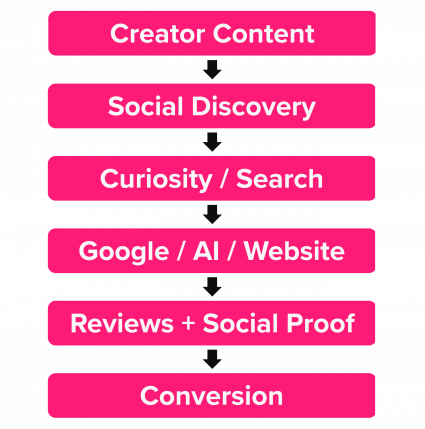
The objective isn't to force every user through this exact journey, but to make sure the next step feels natural wherever they enter.
5. Use behavioural nudges carefully
Here are some behavioural nudges that could help make your Black Friday marketing strategy more effective:
|
Nudge |
Black Friday application |
|
Social proof |
Creator reviews, ratings, testimonials and UGC |
|
Scarcity |
Genuine limited stock or time-limited offers |
|
Urgency |
Countdown messaging and clear deadlines |
|
Choice architecture |
Make the best next step obvious |
|
Cognitive fluency |
Keep messaging consistent across channels |
|
Authority |
Expert reviews, demonstrations and credible information |
|
Familiarity |
Build exposure before the sale |
|
Loss aversion |
Show what the shopper risks missing - without manufacturing false scarcity |
However, it’s important to note that behavioural science shouldn't mean manipulating people into buying something they don't need. The strongest Black Friday strategies use nudges to make a genuinely valuable decision easier to understand and easier to act on.
Key Takeaways
- Social Media is the New Storefront: The Black Friday path to purchase begins in the scroll. Almost half of UK internet users search for products on social media, making platforms like TikTok, Instagram, and Facebook critical for driving early brand exposure.
- Social Proof Beats Discount Noise: Standout deals alone aren't enough when everyone is shouting "20% off". Creator reviews, unboxings, and product demonstrations answer key buyer questions and reduce purchase uncertainty.
- Social Content Fuels Search: Video content creates a curiosity gap. A user might discover a product on social media, but they will frequently search Google or query AI tools for comparisons and reviews before converting.
- Social Comments are an SEO Goldmine: Don't just research keywords; look at creator comments, TikTok searches, and customer objections. Use this real audience language to inform your Black Friday SEO strategy, website copy, and FAQs.
- Start Before the Peak: Use September and October to run top-of-funnel paid campaigns (like Spark Ads). Building warm custom audiences early keeps CPMs lower and primes shoppers weeks before the sales begin.
Ultimately, for the most effective Black Friday strategy, you need to be bringing SEO, paid media and social together to turn early discovery into lasting brand familiarity, build consumer confidence and drive conversions long before shoppers reach the search bar.
Is your Black Friday strategy ready for the multi-platform searcher?
From social search discovery and paid amplification to LLM optimisation, our team blends behavioural science and search strategy to ensure your brand gets discovered wherever your customers start their journey. Get in touch with Reflect Digital today.
Contact Us
MEET THE AUTHOR.
AMELIA MILES
Amelia is our Senior SEO Executive, immersed in the world of digital marketing. She brings enthusiasm and applies creativity and psychological insights to our SEO, content and email marketing strategies. With her natural curiosity and commitment, she contributes to our mission of helping clients achieve their goals and delivering results, and is a positive addition to the team. She also loves getting involved in our Aspiration Digital and BIMA Digital Day events, helping to nurture the future generation of marketers.
More about Amelia