

How to Use Behavioural Nudges to Increase Donations


How using behavioural nudges in content can increase donations for charities
For charities with tight budgets and big missions, behavioural nudges are a powerful tool to turn empathy into action. Our behavioural specialists have helped charities, such as the RSPCA, to elevate their donor communications by incorporating useful nudges that make building connections, evoking emotions and securing donations easier than ever. Now, we’re here to help you do the same.
In this blog, we’ll take you through how to transform a passive supporter into an active donor, through personalisation, connection and simplification.
#1 Personalisation
Whether you’re trying to increase donations as a charity, build relationships with journalists for PR campaigns or elevate your monthly eCommerce email to double conversions, personalisation is the key to creating impactful content that resonates with users.
Personalisation is a particularly powerful tool for charities because people want to see themselves in the cause. When messaging taps into personal identity, donations feel like an expression of self. So, the more tailored your content is, whether it’s an email appeal, direct mail newsletter or landing page, the more likely it is to evoke emotion and generate a higher number of donations.
Behavioural nudges can be a really simple way of personalising your content. Tiny changes to the way you word something can have a huge effect on how your communications resonate with people. There are a couple of behavioural nudges in particular that will transform your content from generic to meaningful:
-
Social Identity - The principle that people affiliate with a specific group based on similar personal characteristics which can foster a sense of community. You can tailor your content for specific groups, interests, characteristics or personality traits that will align with prospective donors and encourage them to donate.
For example, if you’re an animal rescue charity and have data on whether donors have sponsored or donated more for specific animals, you can create content around those animals to encourage them to raise their donation. According to research, dog lovers tend to be more active, playful and extroverted, while cat lovers tend to be more introverted, so you can adapt your content to suit their personalities.
-
Framing - The principle that the presentation of information influences our decision making. Presenting the same information to two people in different ways can have a much bigger impact than keeping it the same across the board.
This is particularly useful if you’re including statistics in your content. Large, random numbers can be difficult to resonate with and put into perspective. For example, the total number of people helped by your charity in the past year. While it’s an important statistic to talk about to encourage more people to donate, large numbers can feel impersonal and difficult to comprehend.
By framing statistics in the context of something familiar, it can help people resonate with the numbers and understand their impact better. For example, if you have access to regional information, you can localise statistics e.g. ‘we’ve helped 60,000 people this year…in other words, we’ve sold out the O2 Arena three times’. If the recipient of your content is familiar with the location you’re talking about, it’s easier for them to visualise the impact of their donation and it can feel more tangible that their support is going to make a difference.
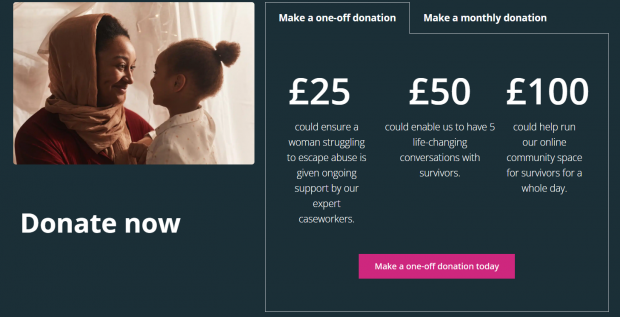
In the example above, Women’s Aid have framed donation amounts by contextualising them with the impact they can have. £50 is just a number, but ‘5 life-changing conversations’ is something real that donors can easily understand.
#2 Connection
Ultimately, donations are emotional - people give to charities because they feel connected to a specific story or a collective need. Therefore, your content needs to tell a story that resonates and builds a meaningful connection with potential donors. Once they’ve donated, you want to continue developing your relationship with them so that they become a regular donor, sponsor or volunteer.
It’s important to note that evoking emotion and building connection doesn’t mean guilt-tripping or making people feel bad about not donating. You want people to feel compelled to donate because they really believe in your mission and they truly understand the impact their donation can have. If you make people feel bad about not donating, they likely won’t feel empowered to want to make a difference next time.
So, how can you use psychological nudges to connect with potential donors without evoking feelings of guilt?
- Identifiable Victim Effect - The principle that telling the story of one entity rather than a group is more likely to have an emotional impact and move people to take action. Case studies offer the most prominent opportunity to use the Identifiable Victim Effect. You can share a single experience of how your charity has made an impact, and then keep making references to the case study in other communications.
Each time you mention the experience (e.g. the person or animal’s name), donors are reminded of how they felt when they first read about it, which can drive emotion, continue to build the user’s connection with your charity and encourage them to take action.
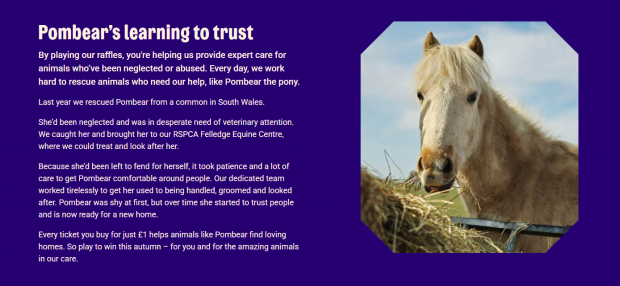
In the example below, the RSPCA have shared a case study about Pombear, a horse who was rescued. Alongside the heartbreaking story, they have also added a photo of Pombear, so that whenever Pombear is mentioned in any other communications (e.g. emails or direct mail newsletters), donors will visualise the beautiful horse, be reminded of how the RSPCA was able to rescue her and be more likely to donate as they know the impact their support can have.
-
Social Proof - The principle that people tend to conform to the actions or opinions of others when they are uncertain about what to do. Trust and connection go hand-in-hand. Before your content can truly reach the hearts of donors, they need to be able to have faith in what you do and believe that their support can really make a difference. This is where social proof comes in.
Social proof is one of the biggest trust signals you can add into any content, whether you share the first-hand experience of another supporter, or someone who’s been impacted by your charitable efforts. When donors see that other people have had a positive experience with your charity, it makes them more likely to trust that their donations will be used honestly and effectively, therefore making them more likely to either donate again or increase the amount.
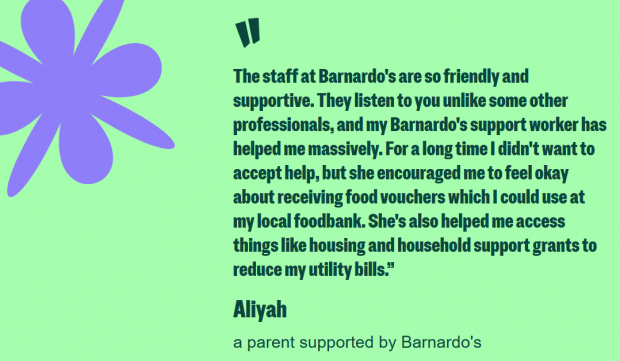
In the example below, Barnado’s have added a testimonial from a parent who has received support from the charity. By explaining how they’ve been supported on an emotional (from not wanting to accept help to receiving food vouchers) and practical (access to support grants) level, the testimonial provides ‘proof’ of just how crucial donations can be in improving the lives of families in need.
#3 Simplification
If giving takes too many steps, people drop off. Even if they want to help your charity and believe in the cause, if you make it too difficult for people to get involved, they won’t. This is the ‘intention-action gap’, people want to do good, but they get distracted, overwhelmed, or simply put it off for later.
This is where behavioural nudges come in. Small, subtle adjustments in how you write your content can make it dramatically easier for people to follow through on their good intentions. Simplifying the journey makes a huge difference. Also, if donors have an easy, positive experience supporting you the first time around, they’re more likely to do so again in the future, or encourage others to help too.
Two of the best behavioural nudges for simplifying your content and making it easier for donors to support you are choice overload and friction:
-
Choice Overload - The principle that, when given too many choices people find it more difficult to make a good decision. Every person is unique, so it’s understandable that you want to provide as many options to support your charity as possible. After all, the more ways there are to help, the more likely people are to find something that suits them, right?
Well, actually this isn’t always the case. Providing too many options can deter people from getting involved because it can make it too difficult to make a decision. For example, if you list out 15 different donation amounts, they’re likely to spend too much time weighing up which amount is best, become fatigued and put the decision off for another day.
The best way to encourage quick decision-making is to provide a small number of options. Three is usually a good number, especially with donation amounts as you can set low, mid and high options. Usually, people will opt for the middle-ground, so if you set this option a little higher than the half-way point between the other two options, you can increase the average donation amount (e.g. instead of £10, £20 and £40, you could have £10, £25 and £40). This uses another behavioural principle, known as Anchoring, so we’ve given you two for the price of one here!
-
Friction Reduction - The principle that making a desired choice easier by decreasing the effort, time, or cognitive burden required to make it can make actions more likely. In other words, taking away obstacles, no matter how small they are, can make it easier to donate, commit to volunteering or help fundraise.
Obstacles to donating could include having to click through multiple landing pages, not easily being able to select a donation amount, pop-ups continuing to appear on the site or too many fields to fill in when checking out. The goal is to streamline your donation process so the good donors have done outweighs the effort they’ve put in.
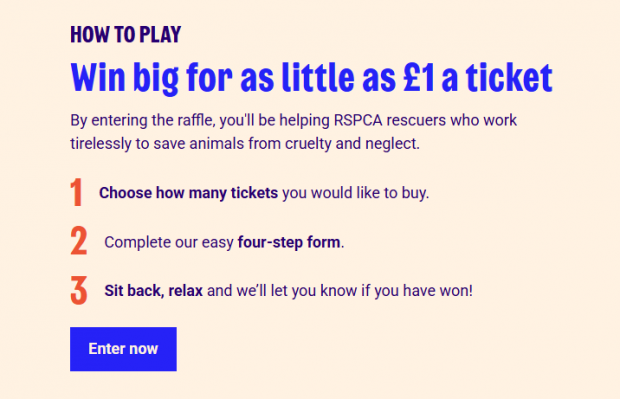
In the example above, the RSPCA have clearly laid-out how and where to enter their charity raffle. By explicitly stating there are only four steps to complete the form, raffle players go into it already knowing how much effort is involved, so they won’t be surprised and are more likely to complete it. They have also added a short sentence above the instructions to remind users of the result of their involvement, therefore framing the low effort of entering against the high impact of supporting animal rescuers.
Learn more about reducing friction in our recent blog on the five behavioural principles every copywriter needs to know.
Key Takeaways
By incorporating behavioural nudges into your content, you can make supporting your charity easier, more compelling and more rewarding for people. Our top nudges to include in your content that will help increase donations include:
-
Social Identity - You can tailor your content for specific groups, interests, characteristics or personality traits that will align with donors. By personalising content, users are more likely to resonate with your cause and donate.
-
Framing - Make your content relatable by framing it in a way that connects with potential donors. Contextualising statistics (e.g. 60,000 = three sold out nights at the O2 Arena) can help people rationalise the impact they can have by donating.
-
Identifiable Victim Effect - Sharing the specific story of how your charity has supported one person (or animal, in the RSPCA’s case), and continuously referring back to their experience in each of your donor communications can evoke more emotion and build a deeper connection than sharing multiple stories or showcasing generic impact statistics.
-
Social Proof - Nudges like social proof help to build credibility, reassuring donors their support will have a tangible impact. Humans are also very social creatures so when we see others giving, we’re more likely to want to give too.
-
Choice Overload - The more options you present donors with, the less likely they are to be able to make a decision which may end up costing you a donation. Whether you’re creating a landing page, email or direct mail newsletter, keep it simple and only present a few donation options at a time.
-
Friction Reduction - The easier you make donating to your charity, the more donations you’re likely to receive. Remove needless obstacles such as broken landing page buttons, unnecessary fields when filling out contact details and complicated donation instructions.
Do you want to create compelling content that resonates with potential donors, increases donations and strengthens connections with existing supporters? Get in touch with us today to learn more about how our human behaviour and content specialists can support your charity with crafting content that makes a difference to your cause.

MEET THE AUTHOR.
MORGAN RODWAY-WING
Wordsmith Morgan joined the Reflect Digital team fresh out of University and is learning about the world of digital marketing while supporting the SEO team with highly engaging content. With a background in website administration and social media, she also brings a broader perspective to her clients.
More about Morgan