Optimising Travel Category Pages for Search and Navigation


Most people do not book a holiday the first time they look. They land on a page listing every sailing holiday in Greece or every villa in Croatia, scroll for a while, and leave to think about it. Then they come back, sometimes days later, and do it again.
That page is a category page. For most travel brands, it does two jobs: it ranks in Google for the terms people search, and it is where a visitor decides whether to keep going or head back to the results. Get it wrong and you lose them at both ends. Which is why it sits at the meeting point of technical SEO and human behaviour.
The two want opposite things. Keyword research rewards detail - every term looks like it deserves a page. Good navigation rewards restraint - every extra choice adds effort. Travel feels this most sharply: destination, holiday type, duration, group size, departure month. Four options in each produces over a thousand combinations. That is choice overload, and people respond to it by delaying or leaving.
It matters here because holidays are bought slowly. Mintel reports 84% of UK consumers took a holiday in 2025 - but across many separate visits, as our SearchPulse travel research tracks. Your category page is returned to, compared, and abandoned before anyone commits.
In this blog, we will explore which terms deserve their own page, what unnecessary depth costs you, and how to design filters that work for search engines and people.
Why Travel Category Pages Are Harder Than Most
Holiday research is long, spread across many sessions, and heavily shaped by other people’s opinions. The IPA found that 91% of UK adults who book holidays research the destination first, spending just under a month on average - 3.8 weeks overall - rising to 4.3 weeks among Gen Z, who research the longest despite booking closest to departure.
Two things follow from that.
First, one page has to serve people at completely different stages. Someone six weeks out is still choosing between countries. Someone six days out is comparing dates and prices. Both land on the same page.
Second, that page is reached from very different searches - broad ones like "sailing holidays", specific ones like "sailing holidays Greece", and detail-led ones like "catamaran charter Croatia". This destination-first mindset is something we have written about before in the context of winning more direct bookings for accommodation providers.
Behavioural triggers at work
Several behavioural principles are active on a travel category page at once. In plain terms:
- Choice overload - too many similar options make people delay rather than decide.
- Hick’s Law - more options means slower decisions, so cluttered navigation measurably slows people down.
- Processing fluency - things that are easy to read and compare feel more trustworthy, regardless of whether they are actually better.
- The default effect - people tend to accept whatever is already selected, which makes your default sort order a commercial decision, not a technical one.
- Anchoring - the first price someone sees becomes the reference point they judge every other price against.
If you want to go deeper on how these principles apply across the wider booking journey, our piece on enhancing customer experience in travel with behavioural science covers chunking, friction costs and visual cues in more detail.
Using Semrush to Decide Which Terms Deserve a Page
The instinct, when keyword research returns 2,000 terms, is to keep building pages until the list runs out. A better approach is to set a small number of page levels and sort every term into one - and this is a decision you can make with data rather than instinct.
To show what that looks like in practice, the three examples below all come from the same brand: Dream Yacht Charter, a sailing holiday operator with a large destination footprint. Nothing here requires a paid audit to replicate - all three views are standard Semrush reports you can run on any domain in a few minutes.
1. Check whether the term is searched at all
Start in Keyword Overview, using Bulk Analysis to compare several versions of the same search side by side. The point is to see how quickly demand disappears as a phrase gets more specific.
Take four levels of the same idea. "Sailing holidays" - the broad, category-level term - returns 2,400 monthly searches. Narrow it to a country with "sailing holidays Greece", and it is still healthy at 1,300. Add the boat type, "catamaran holidays Greece", and it falls to 140. Add a duration on top of that, "catamaran holidays Greece 7 nights", and there is no measurable volume at all.
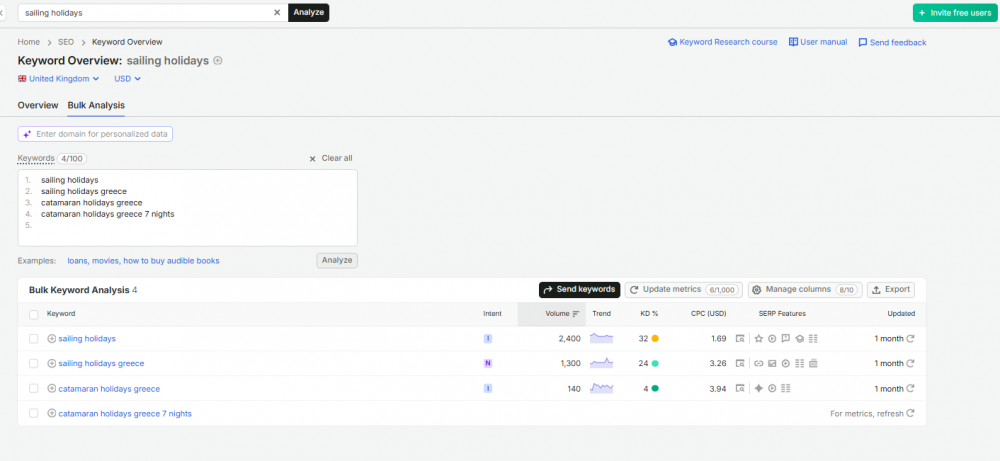
Search volume falls away sharply as terms get more specific: 2,400 for the broad term, 1,300 at country level, 140 for the product variant, and nothing measurable for the detailed combination. The detail belongs in filters, not in pages.
That collapse is the whole argument in one table. There is real, sustained demand at the category and country level, which justifies a page. Below that, the demand thins out and then vanishes - so a page built for it will never earn its place in your navigation. Duration, month and group size are filter jobs, not page jobs.
2. See which page is actually doing the work
Next, look at how a well-structured site handles a cluster of closely related searches. In Organic Research, open the Positions tab, filter by a destination and set a minimum volume so you are only looking at terms that matter.
Filtering Dream Yacht Charter for "Greece" shows something striking. A single URL - the bareboat charters page for Greece - ranks in first place for roughly ten different phrasings of the same search: bareboat charter Greece, bareboat yacht charter Greece, bareboat sailing Greece, bareboat charters Greece, bareboat hire Greece, bareboat rental Greece, and several more. Together, those terms represent around 1,900 monthly searches, all captured by one page.
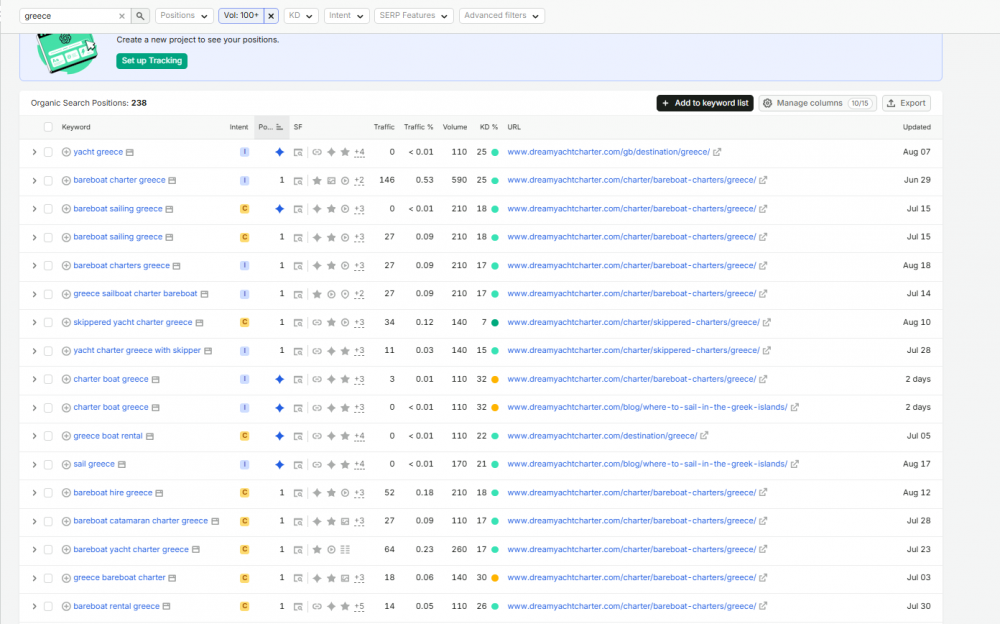
One bareboat page ranks first for around ten phrasings of the same search, worth roughly 1,900 monthly searches combined. Skippered charters get their own page - because that is a different product, not a different way of saying the same thing.
A brand that built a separate page for each of those phrasings would have ten weak pages competing with each other instead of one strong page winning outright. Google is perfectly capable of understanding that "bareboat hire Greece" and "bareboat rental Greece" are the same request.
The same screenshot shows where a separate page is justified. Skippered charters in Greece has its own URL, and it also ranks first for "skippered yacht charter Greece" and "yacht charter Greece with skipper". That is not a rewording of bareboat; it is a different product with its own audience and its own demand. That distinction is the test in miniature: one page for a cluster of phrasings, a separate page only where the underlying need genuinely differs.
3. Look at the shape of your whole site
The third view zooms out. The Topics report in Organic Research groups a domain’s rankings into themes and sizes them by traffic, which gives you a picture of where performance is concentrated and where it has been spread too thin.
For Dream Yacht Charter, two blocks dominate: Caribbean Charters, carrying around 10,000 monthly visits against 435,000 in available volume, and Mediterranean Charters at roughly 4,400. Within Caribbean, a single topic - yacht rental - accounts for 871 keywords on its own. Alongside those two blocks sits a long tail of much smaller clusters, several of them barely registering.
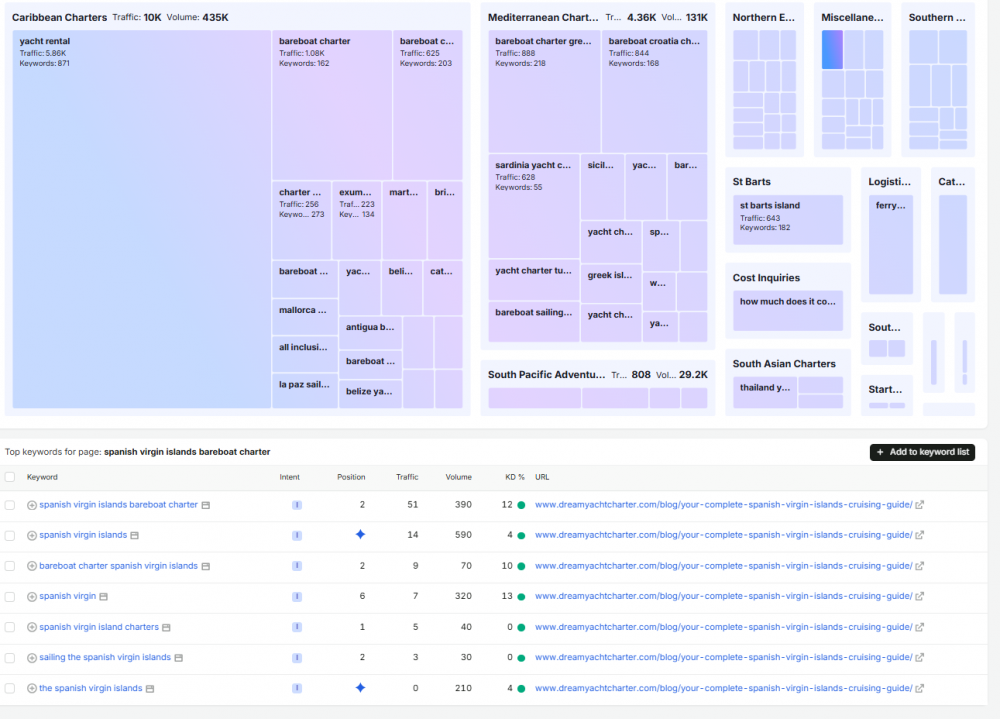
The same site viewed by topic. Two clusters carry most of the organic performance while a long tail of smaller topics earns almost nothing - the pattern that signals over-fragmentation.
This is the view worth running on your own site first, because the pattern is usually obvious the moment you see it. If a handful of topics carry your organic performance and everything else is a sliver, those slivers are your consolidation shortlist. Reviewing them properly sits naturally within a wider SEO audit.
A workable page structure
For most travel brands, three levels are enough:
- Region - for terms that cross several countries, such as "Mediterranean sailing holidays". These pick up broad, early-stage interest and act as hubs.
- Country or destination - the commercial workhorses, such as "sailing holidays Greece". These should be your strongest pages, with real destination content rather than a template with the place name swapped in.
- Product or type - crewed, bareboat, catamaran. Build these only where Semrush shows genuine standalone demand, and you have enough to show on the page.
Everything else - month, duration, group size, price bracket - belongs in filters. Our guide to building a site structure for humans explains why this hierarchy matters for crawling, indexing and keyword cannibalisation, as well as for users.
What Unnecessary Depth Costs You
The argument for keeping things simple is not about taste. It has been measured.
Baymard Institute, which runs large-scale usability testing with participants in the UK, US, Germany, Ireland and the Nordics, recorded more than 900 usability problems relating specifically to homepages, category pages, navigation menus and site structure. In some tests, task completion rates fell as low as 10-30% when people were asked to find fairly ordinary products.
That figure is worth pausing on. These were not obscure requests on badly built websites. They were straightforward tasks on established commercial sites, failing most of the time purely because of how the categories were arranged.
In travel, three problems come up again and again:
- Categories that overlap. If both "Greece" and "Ionian" appear in the menu with no clear relationship, visitors cannot work out which one holds what they want.
- Labels written for Google, not people. "Bareboat Yacht Charter Holidays Greece" is a keyword, not a menu label. It is slower to read, and it feels less trustworthy.
- Dead ends. Filter combinations that return no results damage confidence in the whole website, not just that one page.
Where the Two Priorities Meet
The resolution is simpler than the debate suggests: cover the demand, but do not break up the journey.
A search term earns its own page when it passes three tests:
- Real demand. Semrush shows meaningful search volume for the term itself, not just for the category above it.
- Enough to show. You have sufficient holidays or products to make the page worth landing on. An almost-empty category page is worse than no page.
- Genuinely different content. The page would say something its parent does not. If the only difference is a swapped-out word, it is a variant, not a page.
If any one of those is missing, it belongs in the filters instead.
The Greece example above passes all three for bareboat and for skippered, and fails all three for "bareboat hire" versus "bareboat rental". Applied consistently, this usually cuts a proposed page count considerably - and tends to improve rankings rather than harm them, because fewer, stronger pages concentrate your authority instead of spreading it thinly across near-identical ones. We have seen an internal linking strategy alone deliver a 25% increase in organic revenue, which you can read about in our case studies.
Behavioural Advantage: Designing Filters People Can Use
If filters are doing the work those extra pages were doing, they need to be good.
Baymard’s research consistently finds filtering to be one of the weakest areas across online retail - and the finding is more subtle than "use fewer filters". People benefit from having more relevant filters. What causes problems is when a single filter group runs too long, when nothing is prioritised, and when the interface hides what a choice will do.
Baymard also found that 38% of sites do not offer filters for all the information they display in their listings, which directly causes people to give up - they can see something they care about but cannot act on it.
Five practical moves follow.
1. Prioritise rather than simply add
Put the three or four things that genuinely drive holiday decisions at the top - destination, dates, group size, budget - and tuck the rest away. This reduces how much effort the page appears to demand without taking any capability away.
2. Choose your defaults deliberately
Whatever is selected when the page loads is a nudge, whether you meant it or not. Because of the default effect, most people will not change it - so pick an order that reflects genuine relevance, not just margin.
3. Show numbers and prices early
Put a result count next to each filter option so people can see what a choice will do before they click it. Showing a clear price range early also gives them an anchor, so later prices are judged against a reference point rather than in the dark.
4. Make progress visible
Breadcrumbs and removable filter tags let people see how far they have narrowed things down. This works with the goal-gradient effect: people put in more effort as they feel themselves getting closer to finishing.
5. Let people filter anything you show them
If a listing displays the number of cabins, the sailing area, or the trip length, visitors should be able to filter on it. Anything else is a promise the page does not keep.
Getting this layer right is as much a customer experience job as an SEO one, and it usually needs both teams in the room.
Key Takeaways
- Detailed keyword targeting and simple navigation pull against each other - decide the balance deliberately rather than defaulting to building more pages.
- UK holiday research is slow and spread out, with 91% of bookers researching first over roughly a month, so one category page must serve people at very different stages.
- Demand thins out fast. Search volume for a sailing example fell from 2,400 at category level to 1,300 by country, 140 by boat type, and nothing at all once a duration was added.
- One good page beats ten near-identical ones. A single bareboat charter page ranked first for around ten phrasings of the same search, worth roughly 1,900 monthly searches combined.
- Build a separate page only where the need genuinely differs - skippered versus bareboat is a different product; "hire" versus "rental" is the same request worded differently.
- Apply the three tests before building: real search volume, enough products to fill the page, and content that differs from its parent. Everything else belongs in filters.
- Poor navigation has a measurable cost - Baymard recorded task completion rates as low as 10-30% on ordinary product-finding tasks.
- Filter design is behavioural design: prioritise the important options, set defaults on purpose, show result counts and price anchors, and let people see their progress.
- Next step: run the Topics report in Semrush for your own domain. If two or three clusters carry your performance and the rest are slivers, those slivers are your consolidation shortlist.
Ready to Rethink Your Category Page Strategy?
Optimising category pages is where technical SEO, keyword strategy and human behaviour meet - and getting that balance right has a direct effect on both visibility and bookings. At Reflect Digital, we combine SEO, behavioural insight and travel and tourism marketing to build site structures that both rank and convert. Get in touch to talk through your category pages.
Contact Us
MEET THE AUTHOR.
NARAYAN GOSWAMI
Narayan supports the SEO team at Reflect Digital by executing key strategies that drive performance for clients. He is passionate about delivering high-quality content, on-page optimisations, and technical SEO solutions that enhance website performance and improve search visibility. Narayan thrives on analysing data through tools like SEMrush, Google Analytics, and Google Search Console to uncover opportunities for growth.
He aims to continuously develop his skills while contributing to Reflect Digital's mission of achieving outstanding results for clients. Narayan enjoys being part of a collaborative environment where innovation and excellence are celebrated, and personal and professional growth are encouraged.
More about Narayan