User-Generated Content in Paid Media: Amplifying Brand Advocacy


If you've noticed that polished, brand-first ads don't always land like they used to, you're not imagining it. Buyers increasingly crave content that feels human, relatable and real. That's exactly why user-generated content (UGC) is having a paid media moment, with industry round-ups reporting up to 4x higher click-through rates and around half the cost-per-click of traditional branded ads.
UGC goes beyond "nice to have" social proof. Run well, it's a performance lever: higher engagement, lower costs and stronger trust signals throughout the funnel.
In this guide, we'll cover what UGC in paid media actually is, why it works from a behavioural science perspective, where to deploy it (formats by platform), how to stay compliant, and a step-by-step playbook to start scaling brand advocacy with confidence.
What do we mean by "UGC in paid media"?
UGC in paid media is when brands take content created by customers or creators and promote it through ads. That includes reviews, unboxings, how-tos, testimonials and "day-in-the-life" clips. The key difference from traditional creative is that the content originates outside the brand, and often runs natively from a creator's account.
On platforms like TikTok and Meta, this native execution is now built into the ad products themselves. TikTok Spark Ads allow brands to turn organic posts (from creators or their own account) into ads while preserving likes, comments, music, and watch history. TikTok reports that Spark formats outperform non-Spark ads because they behave like real content, not interruptions.
Meta offers a similar mechanic through Partnership Ads (formerly Branded Content Ads), which let brands promote creator posts through Ads Manager with full targeting, optimisation and measurement, without stripping away the creator's identity or social proof.
Even on Google, where ads feel more traditional, UGC plays a role. Performance Max rewards asset variety, and Google reports that brands improving Ad Strength to "Excellent" drive more conversions on average. UGC is often the most scalable way to introduce authentic, varied creative into those asset groups.

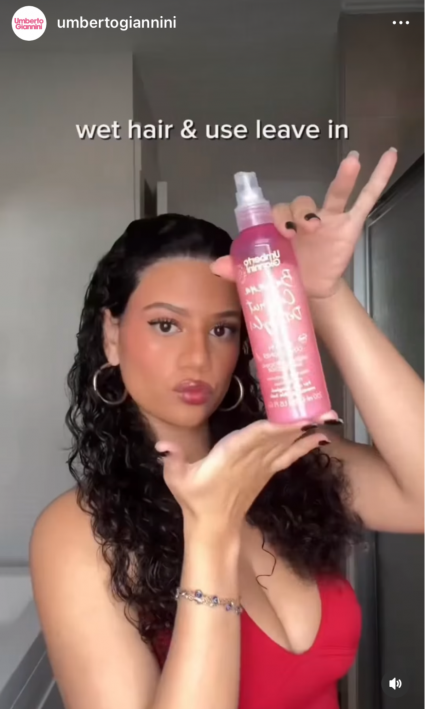
Examples of UGC Content from Glossier & Umberto Gianini
Why UGC works: behavioural science principles
At its core, UGC works because humans rely on shortcuts. Social proof and similarity bias mean people are more likely to trust and copy those who look and sound like them. Seeing real customers in familiar contexts reduces perceived risk and decision friction.
It also speaks to Taste-Tuning, one of the four human drivers of search: people looking for content that fits their own taste and identity. Relatable, lo-fi creators match that need far better than a polished brand ad.
Our SearchPulse Q1 2026 research found that among people who use social media to search, 51% do so because the information comes in a format they like, such as images and video, and 40% because it comes from real people.
There's also a powerful messenger effect at play. Audiences assign more credibility to peers than to brands, even when the message is identical. Research from Nosto and Stackla repeatedly shows UGC is perceived as more authentic than both brand content and polished influencer ads. And authenticity is becoming a competitive edge: in our Q3 2026 SearchPulse research, 52% of Reddit users said they use it because the information comes from real people, more than four times ChatGPT's score.
UGC also taps into commitment and consistency. When customers create reviews, demos or testimonials, they become invested in the brand. That prior action makes them more receptive to follow-up messaging and more likely to advocate publicly. The IKEA effect plays a part too: people value what they've helped create, so customers who make content for a brand tend to feel more attached to it.
Finally, there's cognitive ease. Native, lo-fi content lowers people's "this is an ad" defences, increasing attention and recall. Creator-first platforms like TikTok are explicitly designed to reward this kind of creative variety, which is why their own analyses emphasise it as a performance driver.
The performance case (in brief)
Across multiple round-ups of recent studies, UGC ads tend to deliver higher click-through rates and lower cost-per-click than polished brand ads, sometimes dramatically so. Figures like "4x higher CTR" or "50% lower CPC" should be treated as directional rather than guaranteed, but the pattern is consistent.
For TikTok Spark Ads, platform documentation and agency case studies regularly point to stronger engagement and conversion performance versus non-Spark formats. Meta Partnership Ads show similar trends, with frequent lifts in ad recall and conversion in brand and conversion lift studies.
UGC isn't a silver bullet, but when matched to the right audience, offer and format, it reliably improves attention, trust and efficiency.
Where to deploy UGC (by platform & format)
Read on to learn where to deploy UGC based on platform and format.
TikTok
On TikTok, Spark Ads are the cornerstone. Promoting a creator's existing post keeps comments, music and social proof intact, making them effective for both upper-funnel discovery and direct response. Brands can source content at scale through Branded Missions or the Creator Marketplace, then Spark only the top-performing posts. The key is pace: even strong Spark Ads fatigue quickly, so weekly iteration matters.
Our SearchPulse research (Q2 2026) shows that for 18 to 24-year-olds, YouTube (59%) has now overtaken Google Search (54%) as their top search platform, with Instagram (51%) and TikTok (50%) close behind. Three of their four top search platforms run on video, which is exactly where UGC fits naturally.
Meta (Facebook and Instagram)
On Meta, Partnership Ads allow brands to combine creator credibility with their own targeting and optimisation. These work particularly well when creator hooks are paired with a strong offer and landing page. Alongside this, lo-fi UGC-style content in Reels and Stories, such as product demos, voiceover testimonials and split-screen reactions, helps maintain novelty, especially when rotated across multiple creators. That creative variety matters more than ever as Meta's AI engine takes over more of the targeting.
On Google, UGC is best used as creative fuel. Testimonials, short-form demos and unboxings can populate Performance Max asset groups and YouTube placements, increasing asset variety and improving Ad Strength without the overhead of constant studio shoots.
How to build a UGC-powered paid media machine
Here are 5 ways to build a UGC-powered paid media machine.
Source and secure rights: build a repeatable pipeline
UGC sourcing works best when systemised. Brands can mine post-purchase emails, social hashtags, product reviews, community groups and creator marketplaces to create a steady inflow of content. Just as important are permissions: you need explicit rights to edit the content, run it as ads and, where relevant, use the creator's handle for Spark or Partnership Ads. Keep consent records, and make sure disclosures are clear, as regulators continue to scrutinise non-disclosure closely.
Creative framework: briefs that nudge action
High-performing UGC ads tend to follow a simple structure. They open with a relatable hook in the first few seconds, move quickly into proof through demos or reactions, and reinforce credibility with context cues like timestamps or "real customer" overlays. Behavioural nudges, such as social proof, loss aversion or commitment mechanics, help drive action, while clear, low-friction CTAs close the loop.
Media set-up: match format to objective
Execution should mirror platform mechanics. On TikTok, this means sparking organic posts that already show strong watch-through, then grouping ads by angle. On Meta, it means testing creator versus brand handles and short versus long formats before scaling winners into always-on structures. On Google, it's about uploading multiple UGC cuts to improve asset variety and monitoring incremental conversion impact.
Targeting and sequencing
UGC often performs best when targeting starts broad, letting creator credibility do the work. From there, brands can layer in lookalikes from engagers or purchasers and exclude converted users to avoid burnout. Sequencing also matters: creator-led awareness feeds into comparison and demo content mid-funnel, followed by testimonial-driven retargeting and UGC-reinforced offers.
Measurement and incrementality
To understand what's actually working, lift tests are essential. Meta Conversion Lift and TikTok Brand or Conversion Lift help establish causality. Beyond that, performance should be analysed by creative angle and messenger, with a clear learning agenda. Define hypotheses upfront, test weekly and retire losing creatives quickly.
What are the UK rules for UGC ads?
Compliance isn't optional. Paid or controlled creator content must be clearly disclosed as advertising, in line with ASA, CAP and CMA guidance. Fake or hidden incentivised reviews are banned under the Digital Markets, Competition and Consumers Act 2024 (DMCC Act), and testimonial claims must be substantiated. Both brands and creators share liability in ASA rulings, so robust permissions and disclosures protect everyone involved.
How to keep UGC ads performing long-term
Sustained performance comes from rhythm, not one-off wins. Refresh creative angles weekly on short-form platforms, rotate creators to maintain novelty, and automate sourcing through post-purchase prompts and social listening. Modular editing (shoot once, output many) keeps costs down, while clear guardrails around brand safety, claims, disclosure and accessibility make it easier to scale.
Key Takeaways
- A high-impact performance lever: UGC improves audience attention, trust and creative efficiency when used in native social formats.
- Native formats win: TikTok Spark Ads and Meta Partnership Ads preserve authentic social proof and consistently outperform traditional brand-handle ads.
- Driven by human behaviour: The strongest results come from designing campaigns around real consumer habits, measuring incrementality and staying compliant as regulation tightens.
- Start small: Spark or Partnership-boost your three best-performing organic creator posts and run a lift test before scaling.
- Build the pipeline first: Secure usage rights and disclosures before you need the content.
- Match the platform to the audience: Video-first platforms now dominate search for under-25s, so UGC should lead your creative there.
Want to turn customer love into scalable paid performance? Our team blends behavioural science with platform know-how to build UGC-powered campaigns that convert. Get in touch and let's design your UGC lift test and creative pipeline.
Contact Us
MEET THE AUTHOR.
MYA CLARIVETTE
Mya is a Senior Paid Media Executive at Reflect Digital, specialising in crafting and optimising high-performing PPC and paid social campaigns. She blends data-driven insights with creative thinking to deliver results that truly make an impact, while staying ahead of trends in the ever-changing digital landscape. Collaboration is at the heart of her approach, working closely with teams and clients to ensure every campaign not only meets but exceeds expectations. Always hungry to learn, Mya is committed to growing her expertise while championing innovation, curiosity, and excellence.
More about Mya